5 Things To Help You Overcome Depression

Mental Health Awareness Month takes place the entire month of May, and the theme this year is “You are not alone.”

For those who struggle with depression, overcoming it is not as simple as others might think.

There are those who might say, “Everyone gets depressed. Just get over it,” or, “If you really wanted to be happy, then you would be,” but they don’t realize that overcoming depression does not come so easily as simply wishing for it to happen. As someone who has struggled with forms of depression and who has many family members who have as well, I’ve seen and experienced the difficulty in trying to force yourself to “be happy” even though you feel sad, heartbroken, abandoned, and alone. It often results in burying emotions that need to be worked through and addressed only for them to rise again later and leave you more broken and shattered than before. Forced healing is not lasting healing.

Because May is mental health awareness month, I’ve decided to share with you and those who are struggling five things that have helped me in the process of overcoming feelings of depression. Of course, this post may not be entirely applicable to those who are suffering from severe or clinical depression. If you or someone you know is suffering from clinical depression, please know that there is no shame in reaching out for help, receiving support from a psychiatrist, or asking for prayer. Depression is nothing to be ashamed of because, yes, many people do suffer from various forms of depression and feelings of sadness to varying degrees.

“Forced healing is not lasting healing.”

Instead of trying to ignore or bury those feelings, here are five things you might try to help you begin the process of overcoming it:

1. Listen to music.

Now, some of these tips may seem basic, but just hear me out. When I’ve struggled with depression, almost every single time, I’ve managed to find comfort and feel God’s presence through new Gospel songs I found. One song in particular that spoke to me when I was struggling was “Defender” by Francesca Battistelli.

Listening to music, or music therapy, has proven calming effects that can reduce symptoms of depression and anxiety. When one listens to music, be it instrumental or soothing music, it can help that person experience his or her emotions on a deeper, more visceral level. It may even help clear the mind and make one’s emotions easier to understand.

Just any music doesn’t prove helpful to me, however, which is why I encourage listening to Christian music. As Christians, we understand that our help comes from God, but when we’re struggling with caring for our mental and emotional health, it sometimes becomes necessary to plug into other avenues that help us connect better to His presence. Don’t just listen to the music, but meditate on it. Find new songs that speak to what you’re going through and let yourself praise Him as you listen.

2. Listen to sermons.

We listen to messages over the pulpit every week, but sometimes, it helps to search for an extra word from God throughout the week when we’re feeling overwhelmed with sadness or anxiety. God can minister to us today even through an old message posted to YouTube five or more years ago. One such sermon that I heard when I was struggling and that I’ve returned to often is Victor Jackson’s message at General Conference 2019 called “The Forgotten Anointing.” For those who are weary and full of grief, this message may just be the word from God that will help you begin to heal.

Whether you search for sermons based on what you’re going through or by a preacher you’re familiar with, consider taking notes while listening to the sermon. Write down how God might be speaking to you through the message and ways you can apply it to your life moving forward.

3. Do focused Bible studying.

This one might seem like another no-brainer to those who study the Word consistently, but doing some focused Bible studying is a great way to work through what you’re experiencing by researching it in the Scriptures.

When I found myself in a dark place once, I realized the one thing that might help me get through it was if I could just feel the comfort of God again. So, I began doing a word search for “comfort” in my phone’s Bible app that contains the Strong’s Concordance. As I read verse after verse and studied the original Hebrew meanings of “comfort,” I immediately felt God’s presence. By the next morning, the heavy burden of grief and sorrow that had weighed me down had lifted immensely.

Doing some focused Bible studying on key terms or events in the Bible can help you understand the biblical approach to what you’re experiencing and will take you closer to the presence of God.

4. Get (and stay) involved in church.

It’s natural to want to take a step back from responsibilities at church or even not to want to attend a service or two when you’re struggling with depression, but it’s when you’re struggling that you need that foundation and consistency in your life the most.

Find new ways to get involved in ministry or new ways to use the gifts God has given you for His Kingdom. Go to every service. Continue worshipping God in the worship service and at the altar call. Attend special events or services. Keep in touch with your pastor and church family.

Although it may be difficult and you may feel at times as though you have to put on a smile and pretend you’re okay, the consistency of fellowshipping with the people of God and serving in His Kingdom is one of the most important steps in overcoming depression. The consistency and strong foundation that come with being involved in church bring much needed comfort and peace when you’re going through turbulent times or spiritually dry periods.

5. Do fun things.

Depression can make you feel as though you’re barely surviving and are unable to enjoy even the simplest parts of life, but don’t stop trying to find positive and uplifting things that can make you feel a little less sad for a little while.

Listen to music as we already explored above, or go out to breakfast or lunch with family or friends. Go for a walk at a park. Read a book. (If you need some reading inspiration, stay tuned for next week’s post when I’ll share some book ideas for your summer reading list!) Take a short trip on a day off and go to the lake or hiking or for a simple country drive. Write down your thoughts in a journal.

Whatever you do, do something that takes your mind off your stress and grief and pain if only for a moment and bask in that moment of relief. Every little moment of peace adds up, and eventually, you might find yourself going from feeling sad to being just okay to finally realizing that you are and can be happy in your life in spite of what you’ve gone through.

Overcoming depression is not an easy process and does not look the same for everyone. If you find yourself struggling harder with overcoming depression, try the above tips that have helped me.

Remember that our God is a God of peace. We can find the comfort we need in His presence and in the presence of our church family. Even though you may feel alone, you are not alone. You can overcome depression and be stronger than you were before.

“And the LORD, he it is that doth go before thee; he will be with thee, he will not fail thee, neither forsake thee: fear not, neither be dismayed.”

Deuteronomy 31:8 (KJV)

“Let us therefore come boldly unto the throne of grace, that we may obtain mercy, and find grace to help in time of need.”

Hebrews 4:16 (KJV)

How to Overcome Self-Condemnation: Appealing to the Mercy of God

A man seeks God's forgiveness in prayer.

Sometimes when you make a mistake, the hardest part of forgiveness is forgiving yourself. If you’re like me, you might tend to beat yourself up for mistakes you’ve made, mulling over them at night and asking yourself how you could be so stupid. Self-condemnation completely hinders the process of forgiveness.

When we make a mistake, we must ask God for his mercy and strive to resist temptation and live according to His Word, but sometimes our own thoughts can make it much harder to feel forgiven when we imprison ourselves in our own guilt. What we forget in those moments is how much God truly loves us. In order for us to move forward with peace and in confidence, knowing that He has forgiven us, we must recognize His love for us and that His mercy has no end.

Two examples in His Word show us what it means to appeal to God’s mercy.

When Lot and his family escaped Sodom and Gomorrah, he asked God to save a nearby city so that they might flee to it and be saved.

“Behold now, thy servant hath found grace in thy sight, and thou hast magnified thy mercy, which thou hast shewed unto me in saving my life; and I cannot escape to the mountain, lest some evil take me, and I die: Behold now, this city is near to flee unto, and it is a little one: Oh, let me escape thither, (is it not a little one?) and my soul shall live. And he said unto him, See, I have accepted thee concerning this thing also, that I will not overthrow this city, for the which thou hast spoken. Haste thee, escape thither; for I cannot do any thing till thou be come thither. Therefore the name of the city was called Zoar.”

Genesis 19:19-22 (KJV)

One of the first things Lot said to God was a reminder that God had granted Lot grace and that He had “magnified [His] mercy” by saving Lot’s life. When Abraham went to God to try to convince Him not to destroy Sodom and Gomorrah, he appealed to God’s justice, asking if God would destroy the “righteous with the wicked” (see Genesis 18:23). Abraham did not succeed in his intercession for Sodom and Gomorrah, but Lot succeeded in his intercession for Zoar by appealing first to the grace and mercy of God when he was in danger and needed to be saved.

In the New Testament, Jesus told a parable of humility and mercy when comparing the Pharisee to the publican.

“Two men went up into the temple to pray; the one a Pharisee, and the other a publican. The Pharisee stood and prayed thus with himself, God, I thank thee, that I am not as other men are, extortioners, unjust, adulterers, or even as this publican…. And the publican, standing afar off, would not lift up so much as his eyes unto heaven, but smote upon his breast, saying, God be merciful to me a sinner.”

Luke 18:10-11, 13 (KJV)

In this parable, the publican acknowledged his sinfulness and asked that God would show him mercy. He showed humility and an understanding of his own faults and need for a Savior.

These examples remind us to appeal to God’s mercy when we are facing difficulties and when we need forgiveness. Lot appealed to God’s mercy when he needed salvation from circumstances. The publican appealed to God’s mercy when he needed salvation from sin. Neither Lot nor the publican were perfect men, but in Lot’s case and in the parable of the publican, both men were sincere in their appeals, and God showed them His mercy. When we make a mistake and ask for forgiveness, we’re stating that we cannot make it on our own. Our appeal to God’s mercy becomes a declaration that we need Him.

Messing up again and again is human nature. God knows this. Of course, our human nature is not an excuse to sin, but rather it is a reminder that we need Him in order to resist temptation and receive forgiveness.

God is just and faithful to forgive of us our sins as His Word says in 1 John 1:9.

What these accounts remind me of is how much He wants to forgive us. Our God longs for us to surrender to Him and serve Him in righteousness and sincerity, and when we do, then He will forgive us of our sins. We need not walk in guilt and self-condemnation because He already paid the price for our sins and freed us from guilt and shame.

We can overcome guilt and self-condemnation by appealing to God’s mercy, by recognizing our flaws and inadequacies, and by understanding that it is only through the grace, love, and mercy of our Savior that we move forward and walk in confidence with Him. Self-condemnation will keep us from accepting His forgiveness, but the self-realization of our weaknesses and His great love for us keeps us under His blood and walking in newness of life.

*****

Post Schedule Announcement:

Lots of things are coming up as my schedule will be getting busier over the upcoming weeks, so posts will be on Fridays only until further notice.

I’ve seen there are some newer readers and subscribers to Breathe Pray Repeat, so I also want to say “welcome,” and I pray these posts bless you and encourage you to get closer to God as you seek Him more and study His Word.

If you have any post or Bible study requests, don’t hesitate to comment below or send me a message and let me know! God Bless!

3 Qualities of a Good Servant

A man opens his Bible.

What makes a good and faithful servant?

Is it simply someone who does good deeds and tries to be kind to others? Is it someone who serves their community? Is it someone who prays an hour every day and fills journals with Bible study notes? Is it someone who goes to Bible college and becomes a preacher or worship leader?

What does it take to simply be that good and faithful servant the Lord will welcome into Heaven?

Well, a person can certainly be a good and faithful servant by doing any or all of the above, but pleasing and serving God does not mean that we have to attend Bible college or that we have to become a preacher or singer. Those things are wonderful things but are specific callings rather than general requirements for all Christians.

When we study the Word, we see many examples of various people who were faithful servants—Abraham, Job, and Mary are a few that come to mind. One man in particular who appears very early in the Bible shows us three qualities of a faithful servant that are a good foundation upon which we can build and develop a strong relationship with God.

“And Abraham said unto his eldest servant of his house, that ruled over all he had, Put, I pray thee, thy hand under my thigh: And I will make thee swear by the LORD…thou shalt go unto my country, and to my kindred, and take a wife unto my son Isaac…And the servant put his hand under the thigh of Abraham his master, and sware to him concerning the matter.”

Genesis 24:2-4, 9 (KJV)

1. Attentiveness

When Abraham was old, he tasked his eldest and most trusted servant with finding a wife for Abraham’s son, Isaac. Here, we have an example of a servant who was not only attentive to his master’s requests and needs, but he was also mindful of Abraham’s requirements to accomplish his task.

After he met Rebekah and her family, he faithfully repeated to them his errand, detailing every aspect of his oath (see Genesis 24:34-41). A testament to the servant’s mindfulness in completing his task, he even refused their request to let Rebekah stay with her family a little longer:

“And her brother and her mother said, Let the damsel abide with us a few days, at the least ten; after that she shall go. And he said unto them, Hinder me not, seeing the LORD hath prospered my way; send me away that I may go to my master.”

Genesis 24:55-56 (KJV)

In order for us to be good servants, we must not only listen to our Master’s commands, but we must be mindful of how we go about our work for the Kingdom. Abraham’s servant carefully heeded each aspect of his oath to his master. Even though some might deem it unkind to not allow Rebekah to stay with her family a few more days, Abraham’s servant was persistent in fulfilling his task, mindful of the time and his master’s needs. Abraham’s son needed a wife, and it was his job to deliver on his task—pronto!

When we serve in the Kingdom, we must be mindful of how we go about our ministry and of how we answer to God’s commands, which brings us to the second quality Abraham’s servant displays.

2. Obedience

Abraham’s servant was obedient to the letter. He swiftly went about finding his master’s son a wife and made sure she was of the same household as Abraham’s family as his master requested. Now, we know Abraham’s servant had a reputation of faithfully obeying his master because Abraham trusted this man with all of the goods of his house (see Genesis 24:2, 10). Over the course of the chapter, we see that Abraham’s servant was forthright as he set out to the well to find Isaac a wife and was very thorough. Before assuming Rebekah was the one God had chosen for his master’s son, Abraham’s servant watched Rebekah carefully and questioned her about her family:

“And the man wondering at her held his peace, to wit whether the LORD had made his journey prosperous or not…And [he] said, Whose daughter art thou?…And she said unto him, I am the daughter of Bethuel the son of Milcah, which she bare unto Nahor…And the man bowed his head, and worshipped the LORD. And he said, Blessed be the LORD God of my master Abraham, who hath not left destitute my master of his mercy and his truth: I being in the way, the LORD led me to the house of my master’s brethren.”

Genesis 24:21, 23-24, 26-27 (KJV)

Abraham’s servant waited for confirmation to ensure Rebekah was the one God had appointed for Isaac, and then he praised God and continued with his task. A good servant obeys, yes, but a good servant must pay close attention to every detail to ensure complete obedience.

3. A Relationship with God

Finally, a good servant must commune with God. We see throughout chapter 24 of Genesis that Abraham’s servant regularly spoke to and praised God. In fact, he spoke to God and worshipped Him three times in this chapter, showing his trust in God and a thankful spirit.

First, Abraham’s servant surrendered the situation to God by asking God to show him the woman He had appointed for Isaac (see Genesis 24:12-14). Second, he praised God when he realized God had blessed his journey and led him to the right woman (see Genesis 24:26-27). Third, he worshipped God when Rebekah’s family released her to accompany him back to Abraham and marry Isaac:

“Behold, Rebekah is before thee, take her, and go, and let her be thy master’s son’s wife, as the LORD hath spoken. And it came to pass, that, when Abraham’s servant heard their words, he worshipped the LORD, bowing himself to the earth.”

Genesis 24:51-52 (KJV)

Through each aspect of fulfilling his work, Abraham’s servant gave the glory to God and surrendered his task into God’s hands.

A woman throws her hands up in surrendering everything to Jesus.

In order to become the child of God that He wants us to be, we have to start somewhere. Applying to our own lives the qualities that Abraham’s servant shows us will help us begin a foundation for building a healthy and strong relationship with God. When analyzing your own walk with Him, ask yourself these questions: Am I heeding and obeying God’s commands in my life? Am I faithful in my work in the Kingdom? Am I seeking the Lord faithfully? Have I given Him honor and worship for the things He’s done for me?

If we build a strong relationship with God and follow His guidance and instructions for our lives, then He will ultimately bless us with the greatest reward—hearing the words, “Well done, thou good and faithful servant,” as we enter into His Kingdom to be with our King for eternity.

The Temporal vs The Eternal: Tuning Out the World and Tuning into the Spirit

Hollywood held the 93rd Academy Awards ceremony this Sunday, but not many tuned in to see it. In fact, recent polls reveal that the majority of Americans have not even seen or heard of any of the films nominated at the Oscars. This is, of course, very good news.

Ten-plus years ago, I remember hearing of the films that won awards at the Oscars and being somewhat familiar with them. Back then, I watched the short clips of humorous moments that had happened at the ceremony that were still family friendly and did not alienate half of the country because of different values and beliefs. Things are very different now, and the polls that show most Americans did not watch the Oscars or the nominated films may be a sign that the culture of celebrity worship is dying as the average American is more concerned with keeping their job during the pandemic and spending time with their family.

So, why is the tuning out of Hollywood significant for us as Christians?

Because it’s an indicator that many more conservative, centrist, and/or Christian Americans are waking up to what truly matters in our life: the physical, mental, and yes, spiritual wellbeing of ourselves and our families.

One writer on Facebook wrote about how refreshing it is that Hollywood is becoming completely irrelevant to Americans. Many no longer look to the Oscars for entertainment or obsess over films and celebrities that took home several awards.

Instead, they go to work, take their kids to the park, attend church on Sunday, and completely forget that the Oscars were even coming up or happened at all.

This is a sign that our lives truly do not and should not revolve around materialism, consumerism, and temporal things, such as Hollywood, in order for our lives to be fulfilling and purposeful.

Indeed, it is true that the more we spend time in God’s presence and reading His Word, the more we feel fulfilled in Him. The more we focus on living a life that is pleasing to God, the more we invest in our eternity with Him, and the more we tune out the distractions of this world, the more our purpose will come into focus and the more our lives will become balanced and our minds at peace.

“Heaven and earth shall pass away, but my words shall not pass away.”

Matthew 24:35 (KJV)

The decline of Hollywood and celebrity worship culture should inspire us to keep our minds and affection set on things above. Nothing in this world will remain, which means that nothing in this world is worth sacrificing eternity in Heaven with our King Jesus. When we tune into the Spirit, then we can understand the importance of investing in things eternal over things temporal.

Robert Frost wrote a famous poem in 1923 called “Nothing Gold Can Stay,” essentially about the fleeting and fading nature of life. Part of the poem reads, “Then leaf subsides to leaf/so Eden sank to grief/So dawn goes down to day/Nothing gold can stay.” Frost was referring to the golden buds or flowers on trees that turn to leaves before withering away and to the idea that nothing beautiful or seemingly innocent will last. Our lives are but a vapor, after all.

The gold in Frost’s poem takes on a new meaning when thinking of the Oscars. The awards celebrities give themselves take the form of literal golden statues, but each award becomes irrelevant by the time the next awards season rolls around, and they gather again in hopes of receiving yet another award. You see, when you tune into materialism and gorge yourself with a worldly appetite, the accolades and praise from society’s echo chamber become shallow, unsatisfying, and meaningless. When you fail to invest in the Kingdom, life becomes hollow. You lose out on what truly matters, and your spiritual wellbeing falls into decay just like the grass that withers and the flower that fades.

“When you tune into materialism and gorge yourself with a worldly appetite, the accolades and praise from society’s echo chamber become shallow, unsatisfying, and meaningless.”

Hollywood is fleeting. The films they make are not forever. Their fame, fortune, and success will not last.

But the things of God will stand forever while the things of this world will pass away.

So, to those investing more in temporal things and to those in Hollywood obsessed with acquiring their collection of awards, I say: remember—nothing gold can stay.

“Lay not up for yourselves treasures upon earth, where moth and rust doth corrupt, and where thieves break through and steal, but lay up for yourselves treasures in heaven, where neither moth nor rust doth corrupt, and where thieves do not break through nor steal.”

Matthew 6:19-20 (KJV)

“Set your affection on things above, not on things on the earth.”

Colossians 3:2 (KJV)

3 College Tips for Finishing the Semester Strong

Missouri State University
The trees in front of Meyer Library at Missouri State University in Springfield, Missouri, with Strong Hall in the background.
Photo taken May 2020.

It’s that time again when I share tips from my years in college that helped me get through it with good grades and my sanity intact.

The last few weeks of a semester are always busy and stressful. I remember it well—prepping for finals, freaking out when you see how much material the exams cover, calculating what your overall grade might be based off the lowest score you could possibly get, skimming through piles of books and resources you’ve read throughout the semester, stressing over how many papers you have to write at once, planning classes for the next semester. Just bringing it all to memory now makes me a little anxious and weirdly energized.

Every semester, I was convinced my GPA would drop or that I would barely pass an exam or finish a paper on time, but somehow God carried me through it all. Below are three tips that helped me make it through the roughest moments during the end of a semester and prepare for the next one.

1. Don’t forsake the importance of note-taking!

Now, not every student is a note-taker. There were some classes during which I didn’t see the need or simply failed to take notes. As I advanced through college, however, I realized that note-taking was essential to my success. If a professor spent several minutes discussing an important term or event, I jotted down as many details as I could. Taking notes during classes helped me highlight important terms and information for upcoming tests and papers.

If your professor moves too quickly for you to take a lot of notes, consider recording your lectures. Toward the end of a semester, I recorded many lectures in my history and English classes to catch important details about what might be on the exam and how the exam would be structured. This method is especially helpful in preparing for finals because you can always go back to the recorded lecture and write down more in-depth notes!

2. Talk with your professors regularly.

Don’t be afraid to ask your professor every single question or bring up every single concern you have about the exam or final assignments. Really. Ask questions like, “Will such and such material be on the exam? How long of an essay response do you expect? Can we use notes on the exam?” Ask about the paper’s length, referencing style, and amount of sources. It may seem like you are bombarding your professor, but more often than not, your professor will want to help ease your concerns about the exam and give you guidance for how you should prepare for it and your papers.

It also lets your professor know how determined you are to succeed, which always factors into how they perceive you as a student and into your overall success in class. Constant communication with my professors always helped me determine how prepared I needed to be for finals and final assignments, how difficult the exam would be, and what my professors expected in the paper.

3. Prepare for the next semester.

Before registration for the next semester opened, I spent time looking up desired classes and schedules so that once registration day came, I would already know exactly what kind of schedule I wanted and register for it immediately. Classes usually fill up quickly, so don’t hesitate until the last minute or even a week or two after registration opens to plan the next semester.

Once, because I wasn’t at home when registration opened, I had my father do it for me as I coached him on the phone. Get others involved if you need help!

When you schedule classes, here are 3 things to consider: 1) the professor, 2) the time between classes, and 3) the distance between classes. You can use websites like ratemyprofessors.com to look up professors from your university and find out what to expect from each professor—how they grade, what kind of workload they give to students, and even how friendly they are. If you keep the same professors in classes of the same subjects, you’ll be able to develop a good working relationship with your professors, which will help you do better in classes in the long run!

Pay attention to what time each class you’re scheduling takes place and where they are located. During the fall semester of 2019, I had a scheduling issue after the semester began and quickly had to enroll in another class that took place only 15 minutes after my first class…at the OPPOSITE end of the campus! Needless to say, I was always rushing across campus to get to class in time, making my blood sugar drop constantly! If you schedule your classes in advance, aim for at least 30 minutes between classes that are in different buildings (15 minutes for classes that are close to each other), and try to schedule at least an hour break between a couple of classes if you are on campus all day.

Bonus tip: Do all the extra credit you can! This will help you keep your grade up in the class and keep your GPA stable should you not do as well on a final exam as you has hoped.

Siceluff Hall at Missouri State University in Springfield, Missouri. Photo taken August 2018.

Preparation and scheduling are the two most important factors to alleviate stress at the end of a semester. If you take notes, communicate with your professor, and prepare for both the finals and the next semester, you will be able to maintain good grades and be successful in college. As you look back in each semester, you may even find that preparation and a proper schedule has boosted your confidence for the next one.

And don’t forget what is perhaps the most important piece of advice regarding finishing each semester strong: when it’s all over, treat yourself to some cupcakes or cookies and take a well-earned nap to celebrate!

Just breathe, pray, and repeat.

5 Scriptures for When You’re Hurting

A woman dealing with grief

When you’re in pain, sometimes there are no words that can adequately describe what you’re going through.

Whether it’s a physical pain or emotional pain, that feeling of hurt can reach so deeply that it stretches far past the limits of your vocabulary.

People may ask, “How are you feeling?”

And you don’t know what to say. You may not even be exactly sure how you feel.

But we have a Savior who knows our hurt better than anyone. We have a God who experienced physical and emotional pain and who understands grief, hurt, anger, and suffering. We have a Comforter whose words are the only ones that can stretch past the limits of our vocabulary, reach into the deepest trenches of our anguish, and ease the burden of pain and sadness.

If you’re struggling with hurt, here are five Scriptures from His Word that offer an encouraging perspective:

“My flesh and my heart faileth: but God is the strength of my heart, and my portion for ever.”

Psalms 73:26 (KJV)

“He healeth the broken in heart, and bindeth up their wounds.”

Psalms 147:3 (KJV)

“Blessed are they that mourn: for they shall be comforted.”

Matthew 5:4 (KJV)

“Casting all your care upon him; for he careth for you.”

1 Peter 5:7 (KJV)

“And God shall wipe away all tears from their eyes; and there shall be no more death, neither sorrow, nor crying, neither shall there be any more pain: for the former things are passed away.”

Revelation 21:4 (KJV)

God is our strength when our heart fails and our body cannot carry us any further.

He is the Healer of our heart and the Mender of our brokenness.

We are blessed even in our mourning. For when we are in pain and sorrow, He comforts us.

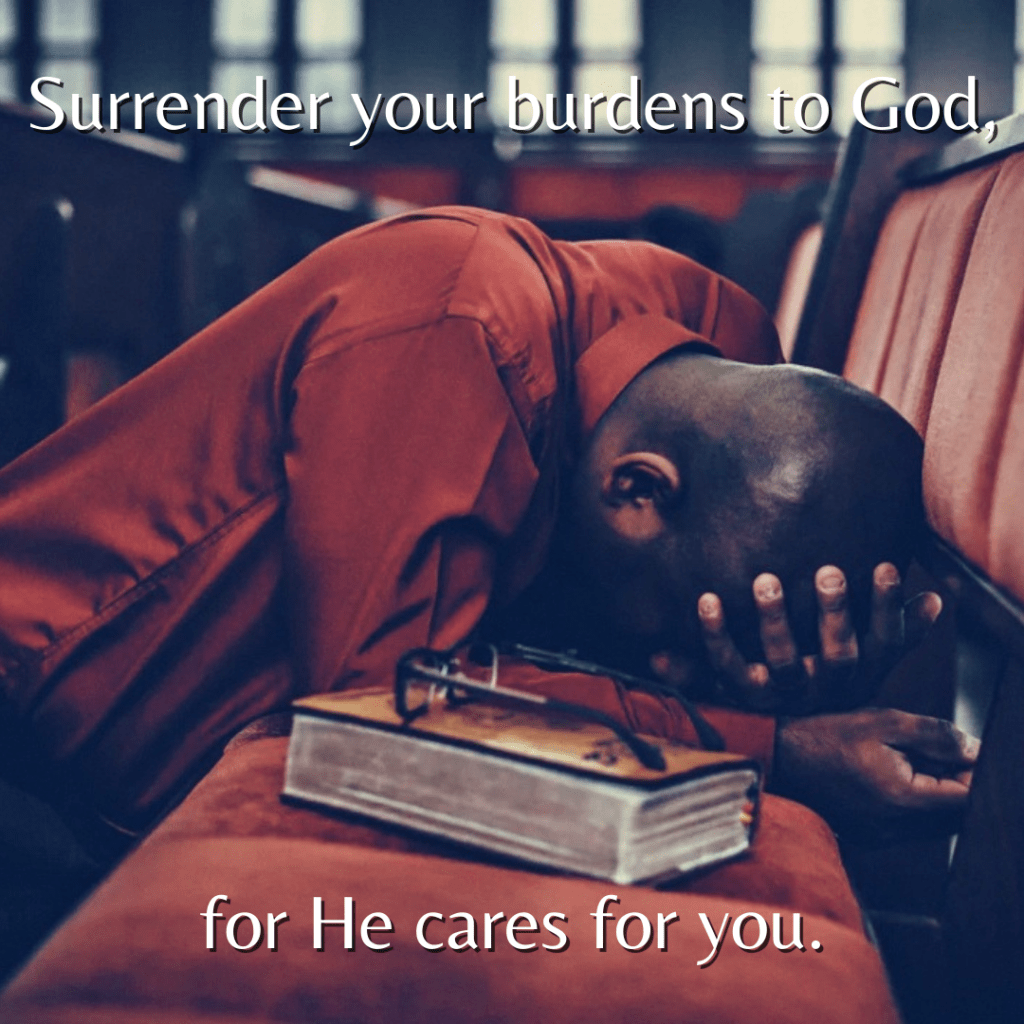
When it’s too much for us to bear, we can surrender all our grief and despair to Him because our God truly cares for us. If it matters to us, it matters to the Master! He knows the pain we’re feeling even when we can’t put it into words or understand it ourselves.

And when our pain seems to overwhelm us, He reminds us of the promise that one day, our God Himself will wipe all tears of sorrow from our eyes, and we will no longer feel any more sadness, grief, or pain.

Just a little bit longer, and we’ll be with our King in eternal joy and freedom forever!

“There’ll be no sorrow there, no more burdens to bear, no more sickness, no more pain, no more parting over there; And forever I will be, with the One who died for me, what a day, glorious day that will be.”

“What a Day That Will Be” by Jim Hill

*****

Schedule Update: There will be no blog post this Friday.

If you’d like to read more about Scriptures on comfort, check out this post from my series on studying comfort in the Bible.

How to Overcome Doubt with Determination

Overcoming doubt with determination by studying the Word.

Ever feel like bad things always happen to you, or like you just aren’t as lucky as those other people on social media who are living the dream and have it all together?

Ever doubt that things will work out because it seems they never do?

Sometimes, we make things harder for ourselves when all we focus on is the negative. It interferes with our ability to trust God and give Him our cares. Doubt can be crippling.

As someone who’s teetered between pessimism and optimism, I know the back-and-forth can make you emotionally and physically exhausted.

“God, I just want something good to happen in my life for once!” I’ve said before.

Our doubt blinds us from seeing how God is working, and it keeps us from moving forward with determination.

Doubt damages our determination.

After all, why bother embracing the future when you can’t see what’s ahead or when it seems bleak and uncomfortable? Why trust that things will work out when it seems nothing good ever happens?

You know, we often get stuck on patterns. If there’s a pattern of negative events in our lives, we come to expect negative things, and negativity becomes the lens through which we see life. As humans, we like patterns because they’re predictable. They give us a feeling of control. If we can predict what might happen, then we can prepare for the worst.

But God does not operate according to the predictions of man. His ways are higher.

When we learn to trust that God always has a plan for our lives, then we can turn our doubt into determination—the kind of determination that says, “I will trust in God no matter what happens.”

God's ways are higher than ours.

We say Thomas doubted that Jesus really had risen from the dead with a kind of disdain for Thomas’ attitude, but I’ve always found Thomas relatable here.

Think about it: Jesus Christ, whom the disciples had hoped would help them overthrow the government, was crucified three days prior. Their movement seemed hopeless and crushed. Bad things kept happening. And all of a sudden, a man stood in front of Thomas claiming to be the resurrected Christ. Perhaps many of us, if we had been Thomas in that moment, would feel it was too good to be true. After tragedy and disappointment, we might have responded to Jesus’ resurrection with hesitation and doubt.

Have you ever asked God for a sign if something really was Him?

God, if this is You moving, send me a sign!

Thomas declared that he would not believe until he had seen the scars in Jesus’ hands and touched His spear-pierced side. How did Jesus respond?

“Then saith he to Thomas, Reach hither thy finger, and behold my hands; and reach hither thy hand, and thrust it into my side: and be not faithless, but believing. And Thomas answered and said unto him, My Lord and my God.”

John 20:27-28 (KJV)

If we are to see Jesus, we must reach out and touch Him.

If we are to overcome our own doubt and pessimism, we must get closer to Him and believe.

Faith comes by hearing, and hearing by the Word of God!

(See Romans 10:17.)

When we study His Word, we begin to hear His voice. When we hear Him, our faith in Him grows. As our faith grows, so does our trust and our confidence in Him.

The more we seek Jesus in determination, the more our doubt will diminish.

4 Ways to Be Consistent in Prayer

How often do you attempt to organize your day perfectly, so you can spend quality time with God, and you fail?

Consistency can be difficult when we get overwhelmed with life and busy with distractions, but it is the key to having a strong prayer life.

Today’s post is taken from Bro. David Brown’s pre-sermon message on this past Friday night at Missouri District Youth Convention. Below is the transcript of an excerpt from the beginning of Bro. Brown’s Friday night message as he describes 4 ways you can be more consistent in your prayer life.

*****

1. Make it a priority.

You’ve got to make prayer first. And I know that all of you, you have things that you do right when you wake up. Hopefully, it involves something like brushing your teeth.

But I wonder if you’re struggling to make prayer a priority in your life, I wonder if you could make up your mind just between you and Jesus to say, “You know what? Before I (fill in the blank).” It could be brushing your teeth. I promise Jesus doesn’t mind your stank breath. But say, “Lord, before I brush my teeth, before I pick up my phone, before I check a text message, Lord, I’m going to spend time with You in prayer and with your Word.”

So, make it a priority.

2. Place—designate a space and time to fully be with the Lord.

I would encourage you to designate a space and a time to be fully with the Lord. Have a place, whether that’s in your bedroom or a specific place in your bedroom. Maybe it’s even in your closet. But have a place where you can eliminate distractions, and you can set aside time just to be with Jesus.

3. A.C.T.S.—have a plan.

I don’t know about you, but at some point, I got tired of going into that time of prayer, and I say, “Hallelujah, thank you, Jesus,” about 1,000 times, and I say that’s prayer. So, I just have a very simple plan. I can’t even remember the first time where I saw it, but my plan is very simple: it’s A.C.T.S.

I start my time with the Lord by adoring Him, by worshiping Him, by just talking about how awesome God is. Then, I go into confession, and I confess the things I’ve done that I shouldn’t have done and the things I should’ve done that I didn’t do, for to him that knows to do good and doesn’t do it, to him it is sin. And I also confess each day that I could not live this day without Him.

And from confession then I move into thanksgiving, and I begin to thank the Lord for the incarnation, that the Word was made flesh and dwelt among us. I thank God for the life of Jesus Christ that though He was tempted in every way as I’m tempted, He was without sin so that He might present Himself a sinless sacrifice. I thank God for every spiritual blessing, every good gift, every perfect gift. I thank God for every spiritual blessing, material blessing, physical blessing.

And after I thank God, then I begin to seek Him. I begin to seek the Lord, and I usually begin by putting on the armor of God, putting off the works of the flesh, and putting on the Lord Jesus Christ. And then I allow the spirit of God to lead me where to pray and what to pray. So, a plan.

4. Playlist—Helps Clock Disappear

And last but not least…this is totally odd-school, but it’s helped me, and perhaps it will help you.

Have a playlist, a set of songs that you pray to, that you don’t necessarily sing to, but they just serve as a means of getting rid of the clock. You forget about the time because you build a playlist—you know exactly how long it is, and so if you’ve got to be somewhere in 30 minutes, have a 30-minute playlist. If you’ve got to be somewhere in 45 minutes or 60 minutes, have a playlist that serves that time.

And typically, I build my playlist to follow my plan. The first song is all about worship, and the second song about confession, and the third song about thanksgiving and seeking the Lord. Before you know it, if I’m praying a playlist, and I’m praying confession or adoration during a song, six minutes and seven minutes and five minutes passes, and before you know it, I’ve spent 30, 45 minutes with the Lord.

*****

The above tips from Bro. Brown are excellent helps for taking a practical approach to be more consistent in your daily prayer life.

If we want to get to the altar and allow God to change us, we must first be consistent in prayer. We must 1) make it a priority, 2) have a place and time designated to be with God, 3) make a prayer plan, and 4) build a playlist to pray along with.

Bro. Brown also mentioned that subscribing to Spotify or Apple Music might be worth the investment if you want to build a prayer playlist so that advertisements do not pull you out of the presence of God:

“There’s nothing like being there with the Lord, and all of a sudden an advertisement for Home Depot comes on. You’ll get out of the altar real quick!”

Bro. David Brown

If we build consistent prayer lives, we’ll be able to develop a closer walk with Jesus, allowing Him to mold and lead us according to His Will.

“Praying always with all prayer and supplication in the Spirit, and watching thereunto with all perseverance and supplication for all saints;”

Ephesians 6:18 (KJV)

“Pray without ceasing.”

1 Thessalonians 5:17 (KJV)

2 Truths and a Lie: Easter Edition

The cross at Calvary sits between the crosses of the two criminals crucified with Jesus.

Resurrection Sunday is less than one week away, and while we’ll be celebrating the resurrection of our King Jesus, there are still so many who will be celebrating Easter as a fun spring holiday about egg hunts and Easter bunnies.

Now, I love the fun aspects of Easter (like egg hunts, special chocolates, and picnics), but Easter is, of course, not about those things in the same way Christmas is not about receiving gifts or simply gathering with family.

It’s all about Jesus.

Sadly, there are many who forget that. There are many who fail to recognize the significance of this holiday, perhaps because they have fallen away from serving God or because no one has reached them with the truth. There are many forms of “truth” roaming around, especially around religious holidays, and there are many lies that distract people from focusing on the truth.

Today, we’ll focus on one lie that the enemy tells to keep people from finding Jesus and two truths that disprove this lie.

The lie: the days of New Testament miracles and spiritual gifts are over.

This is called cessationism, which is the belief “that spiritual gifts ceased after the closing of the biblical canon” (Apostolic Study Bible). Of course, we know this is a lie due to the truths below.

1. Jesus Christ is alive, and so are supernatural gifts and miracles!

Jesus Christ was crucified but rose again and reigns today. If He is alive, and His power still exists, then so do the miracles, signs, and wonders that all stem from His power.

Through the Holy Ghost, we have the power to reach the lost, tread on serpents, discern spirits, prophesy, and interpret tongues among many other things (see Acts 1:8, Luke 10:19, and 1 Corinthians 12). The fact that God’s people can pray for the sick and they be healed and that God’s people can rebuke spirits and perform other miracles is the evidence of Christ’s reigning power and presence.

Jesus is still performing New Testament miracles through His people, which brings us to the second truth.

2. Jesus Christ is still raising people from the dead.

Yes, that means both physically and spiritually. A person can suffer two deaths: physical and spiritual, but the spiritual takes place before the physical. While a physical death does not necessarily resign a person to eternal death (hell), a spiritual death can lead to eternal death if left untreated.

But our God does not abandon the weary, the broken, or the spiritually dead.

When I was struggling with the darkest depression I had ever experienced, I worried I was lost. I worried that there was no way out of that seemingly endless pit because I couldn’t see it. A mix of various emotions consumed me—grief, bitterness, despair, hopelessness. I found myself in a dry wilderness where there was no life and no peace.

But God breathed new life into me.

Through a series of sermons, He began to speak life into me again. After studying certain Scriptures, I began to feel His love and mercy again. After calling out to Him on several occasions, I began to get closer to Him than I had been before, and He brought me out of darkness into His light.

He renewed me. He resurrected me.

If He did it for me, He can do it for you.

Those are the truths we must remember, especially as we celebrate His Resurrection.

Jesus Christ is still on the throne.

He is still healing the sick.

He is still mending broken souls.

He is still saving the lost.

He is still reviving the dead.

He is still moving, and He is not done.

For our God is alive!

Happy Easter, everyone! Thank God for His blood that He shed to cover our sins and give us the chance at eternal life with Him!

I pray you all have a wonderful time celebrating our risen King this Resurrection Sunday!

“And the angel answered and said unto the women, Fear not ye: for I know that ye seek Jesus, which was crucified. He is not here: for he is risen, as he said….”

Matthew 28:5-6a (KJV)

2 Lessons from the Lame Man and the Blind Man: Learning to Recognize Jesus in Your Life

Holding the Bible up to the sky.

What will it take for you to see God in your life?

In the book of John, we see two examples of Jesus healing two separate men—a lame man and a blind man—who both had opportunities to recognize Jesus as their God who had personally touched their lives. Only the blind man recognized God. As for the lame man, there is no record of his salvation, but there is record of his disobedience and lack of gratefulness. When we look at both accounts together, we can see from their differences how important it is to not only glorify and recognize God in our lives but to do whatever it takes so that we can see Him. There are at least two ways the lame man and the blind man differed.

1. They differed in their responses to their peers.

A man looks over the mountains, and a caption reads, "One thing I know: I was blind, now I see."

Both the lame man and the blind man were honest when answering the Jews’ questions about their healings, but the lame man cared more about the interests of his peers while the blind man was able to see through the Jews’ questioning and recognize their antagonistic motives.

“The Jews therefore said unto him that was cured, It is the sabbath day: it is not lawful for thee to carry thy bed. He answered them, He that made me whole, the same said unto me, Take up thy bed, and walk. Then asked they him, What man is that which said unto thee, Take up thy bed, and walk? And he that was healed wist not who it was: for Jesus had conveyed himself away, a multitude being in that place. Afterward Jesus findeth him in the temple, and said unto him, Behold, thou art made whole: sin no more, lest a worse thing come unto thee. The man departed, and told the Jews that is was Jesus, which had made him whole.”

John 5:10-15 (KJV)

“Therefore said they unto him, How were thine eyes opened? He answered and said, A man that is called Jesus made clay, and anointed mine eyes, and said unto me, Go to the pool of Siloam, and wash: and I went and washed, and I received sight. Then said they unto him, Where is he? He said, I know not….They say unto the blind man again, What sayest thou of him, that he hath opened thine eyes? He said, He is a prophet.”

John 9:10-12, 17 (KJV)

The now-healed lame man was at first unable to identify Jesus by name after he deferred blame to Him, but once he learned who it was who had healed him, he went back to the Jews to inform them that it was Jesus “which had made him whole.” The blind man appeared to care more about pleasing the Jews who were after Jesus than obeying Him. The healed blind man, however, knew Jesus by name and (inadequately) described Him as a prophet.

As they questioned him further, he discerned the Jews’ motives to catch Jesus and remained true to his testimony, refusing to be swayed by his interrogators. Pay attention to his response below:

“He answered, and said, Whether he be a sinner or no, I know not: one thing I know, that, whereas I was blind, now I see….Then they reviled him, and said, Thou art his disciple; but we are Moses’ disciples. We know that God spake unto Moses: as for this fellow, we know not from whence he is. The man answered and said unto them, Why herein is a marvellous thing, that ye know not from whence he is, and yet he hath opened mine eyes….Since the world began was it not heard that any man opened the eyes of one that was born blind. If this man were not of God, he could do nothing.”

John 9:25, 28-30, 32-33 (KJV)

The formerly blind man was now defending Jesus against the Pharisees’ accusation that Jesus was a sinner, discerning their attempts to disprove his story and smear Jesus. He pulled from his theological knowledge to expose the flaws in the Pharisees’ argument, confirming to them that if Jesus had been a sinner, He would not have been able to heal the blind man, proving that He was “of God.” The healed man’s bold and clever responses to the Pharisees resulted in them casting him out of the synagogue (ex: “They answered and said unto him, Thou wast altogether born in sins, and dost thou teach us? And they cast him out” [John 9:34, KJV]). Even though the healed man knew what might happen to him, he stood his ground against the Pharisees.

2. They differed in their responses to Jesus.

Jesus bends down and draws in the sand.

While both men initially obeyed Jesus’ instructions to be healed, the formerly lame man disobeyed Jesus later and failed to recognize who He is, whereas the formerly blind man responded to Jesus with both recognition and praise. Notice the blind man’s response to Jesus below:

“Jesus heard that they had cast him out; and when he had found him, he said unto him, Dost thou believe on the Son of God? He answered and said, Who is he, Lord, that I might believe on him? And Jesus said unto him, Thou hast both seen him, and it is he that talketh with thee. And he said, Lord, I believe. And he worshipped him.”

John 9:35-38 (KJV)

The now-healed man recognized Jesus as Lord and worshipped Him, eager to believe. When Jesus told the formerly lame man not to sin anymore, the man turned right back around and tattle-taled on Jesus to the Jews.

One man recognized Jesus as Lord, and the other man failed to see who Jesus is, and his information to the Jews resulted in the Jews’ plan to persecute and kill Jesus.

From both of these accounts, we can glean at least two lessons:

1.) We must value God and the things he wants from us above all things, even if it costs us.

2.) We must not forget to give Him the glory for all He’s done for us.

The formerly blind man recognized and praised Jesus even after the Pharisees had excommunicated him from the synagogue for his defense of Jesus, but the formerly lame man did not recognize or believe on Him. He placed more value in pleasing the Pharisees. In fact, he showed no interest in obeying or praising Jesus whatsoever, perhaps proving he was the true blind man as were the Pharisees for lacking spiritual vision (see John 9:39-41).

A boy looks up at the sunset over the trees. A caption reads, "What will it take for you to see Jesus?"

What will it take for you to see God in your life and give Him the glory?

We may find ourselves going through the motions and doing what we’re told (as both men initially did when Jesus gave them instructions to be healed), but as we learn from the account of the lame man, we can still fall short of recognizing God at work in our lives.

Each day, we must look inside ourselves to ensure we are placing Jesus above all things in our lives. Getting closer to Jesus requires an attitude of willingness, devotion, dedication, and sacrifice. The kind of attitude that says, “No matter what it may cost me, I will stand by Jesus and testify of this truth.” The kind of attitude that makes us willing to remove anything that might keep us from recognizing Jesus. The kind of attitude that says, “I will do whatever it takes to follow and obey Him no matter what.”

If we want to see Jesus, we must devote ourselves to Him, give Him the glory, worship Him alone, and tell the world of His greatness.