Who can know what tomorrow will bring? Who can know what lies in store in 2024?
You wonder, you ponder, you predict what may come—the good, the bad, the in between. You try to prepare, you set your goals, your faith rises, hope soaring high.
But what if?
What if this or that happens? What if your dreaded fears become reality? What if the bad becomes the ugly, the ugly becomes worse, the worst becomes the new normal? What if,what if, what if?
Dwelling on the unknown produces anxiety. Dwelling on the all-knowing One produces peace.
God is with you in the unknown.
“Behold, a virgin shall be with child, and shall bring forth a son, And they shall call his name Emmanuel, which being interpreted is, God with us.”
Matthew 1:23 KJV
Immanuel—God with us.
With: accompanied by, in the company of, support, possessing something.
In other words, with describes a state of being.
God is with us. God is. Is—another state of being verb. Together, “God is with us” implies the omnipresence of God.
Yes, He was there from the beginning. Yes, He’s with you now. And, yes, He’s with you already in 2024 in your deepest, scariest unknowns.
He’s there in every place and every trial, lonely moment, sorrow, and difficult decision in every point in time all at once. Before you even arrive at a certain moment in time, He’s already there. He goes before you.
“And the LORD, he it is that doth go before thee; he will be with thee, he will not fail thee, neither forsake thee: fear not, neither be dismayed.”
Deuteronomy 31:8 KJV
And we know that nothing catches Him by surprise, though we know not the future. Our understanding is limited, our knowledge finite. It is only through trusting in the One with infinite knowledge and who is always with us that we can step into the unknown with confidence and peace.
God is with us. God is faithful. God is.
As we close out 2023 and prepare for a new year, may we remember that God is with us already in everything we may face. And may we turn our worst “what if” scenarios into our best declarations of faith.
What if I get that job? What if I pass that test? What if God heals me? What if God restores my family? What if I’m delivered? What if God shows up like He never has before?
Follow and put your trust in the One who makes all things new and who turns bad situations around for your good. The same God who delivered, healed, and restored in the biblical age performs those same miracles today.
With describes a state of being, and we know that God never changes.
Our unchanging, holy, miracle-working God is with us right now, tomorrow, next year—always.
2023 isn’t over yet, but around Thanksgiving, I begin to reflect on the year – the ups, the downs, the good, and the bad. This year’s been a mixed bag for me, honestly. I’ve had a lot of wonderful times with people I love, and God has shown me things and blessed me in ways I never expected. And yet it’s as though every good moment has been countered with a tough and challenging setback.
You can get to the point where it becomes hard to feel genuinely thankful even in spite of the obvious blessings you know you still have and are thankful for. Weariness can do that to you. Burnout and being stretched thin can take the passion out of your spirit. And you find yourself just wanting to lie down instead of taking care of the million other things on your to-do list or instead of having to actually think about the issues that you’re facing.
I’m sure we can all say we’ve been there. Many wise people will remind us that when we place each anxiety-inducing situation into God’s hands and trust Him with it, then we’ll have peace, and things will be okay. And that’s absolutely true. I’ve reminded myself and others of that before as well. God will work things out in His timing. He takes care of His children.
But we’re all human, after all, and those problems often don’t immediately go away even when we say we’re trusting God with them. Sometimes they still eat away at you. Sometimes they still haunt you, and even when you think you’ve surrendered it, they plague your mind and drag you back into the mud. And there you are – covered in the grime of frustration, weariness, and anxiety once again.
I could go on and on about the ways stress and frustrating times make us feel, but I digress. How can one find a way to feel thankful in the midst of trying times? I’ve been thinking about this, and God reminded me of something so simple, but so good.
Two things came into my spirit: the God who hears me and the Lord my Sustainer.
All of the conversations I’ve had with God about what I’ve been facing this year, every question I’ve asked Him, every prayer I’ve prayed, every moment where I’ve just rambled about a dozen different frustrations, every single word and prayer and cry has not gone unheard. While I sat and wondered about how to write a post about thankfulness that didn’t feel generic, God simply reminded me of this.
He has heard you. He’s listening. He’s there.
“In my distress I called upon the LORD, And cried unto my God: He heard my voice out of his temple, And my cry came before him, even into his ears.”
Psalm 18:6 KJV
In every low moment, God heard me, and He hears you. In every moment when I wasn’t sure how I would make it, God sustained me.
“I sought the LORD, and he heard me, And delivered me from all my fears.”
Psalm 34:3 KJV
Sometimes in life there are those situations that just won’t go away, but the Lord will sustain you. You’re not strong, but He is. You can’t do this, but He can. And with His grace and mercy He will give you the strength to endure.
“But he that shall endure unto the end, the same shall be saved.”
Matthew 24:13 KJV
I’m reminded of the word God spoke through Reverend Victor Jackson at the UPCI General Conference in 2019 – the Forgotten Anointing. It’s endurance. Jesus saw those who followed Him were weary, and He was moved with compassion.
“But when he saw the multitudes, he was moved with compassion on them, because they fainted, and were scattered abroad, as sheep having no shepherd.”
Matthew 9:36 KJV
If you’re going through a rough season this Thanksgiving, and your thanksgiving spirit feels a little stale, it’s OKAY. You’re human, and real life presents real problems. It’s normal to become weary and tired, but thank God for His compassion on us and that He sent His Spirit to dwell within us and bring us comfort and strength.
“I will not leave you comfortless: I will come to you.”
John 14:18 KJV
Maybe you’re still dealing with the same situation that you’ve been facing all year. Maybe it’s a years-long situation. Maybe you’re struggling with feeling truly thankful, and you’re weary of the same issues day in, day out. You cannot and will make it not by your own strength, but you WILL make it by the power of the Sustainer, by the mercy of the Comforter.
Let God sustain you. Pray His Word out loud, and let His Spirit strengthen yours. He hears your every cry. And let this truth reignite your thanksgiving this holiday season: Jesus is the God who hears us. He is the Lord our Sustainer.
“Come unto me, all ye that labour and are heavy laden, and I will give you rest.”
You’re wondering when something might come, if it even will, or what that something may turn out to be. And it isn’t easy to be there for a long time. Most of us know at least a little of what that’s like, and the longer you’re in the waiting room, the more it seems that the something you’re waiting for will never happen. You watch the clock, your mind on the deadline, but your miracle and answered prayer doesn’t appear to be any closer to becoming reality.
But our God is the God of the eleventh hour. He is the God of the midnight hour.
I know a little bit about waiting.
I waited and waited and waited for a full-time job for over a year. I desperately applied at countless places. When I finally snagged an interview for my dream job, I believed the deal was sealed, and my miracle was in the bag. After all, it was what I’d been praying for and what I was hoping would happen for months.
I didn’t get the job.
When it seemed like I had no other options and all hope was lost, God granted me a midnight-hour miracle. And it was greater than what I had expected all because if I had gotten the other job, I may have thought that it was partly because of my “qualifications,” my “experience,” my “perfect” interview. God blessed me with a job I desperately needed, and He did so in a way that proved that it was only because of Him, not me.
Sometimes, we need to hang on to hope for a greater, midnight-hour miracle.
Lazarus was sick and dying, and Jesus could have healed him when he was just sick, but Jesus waited. And it was after Lazarus had been in the tomb for four days that Jesus arrived and raised Lazarus up (see John 11). Jesus performed an ever greater miracle.
When your miracle seems dead, He can resurrect the promise. He can bring back hope when it seems lost.
I love the line from the Elevation Worship song “Welcome Resurrection” (linked here) that goes, “He’s still the resurrection even when the tomb is sealed!”
This is why we can’t give up in the waiting room or even in the eleventh hour. And even as midnight passes, we must keep believing for a greater miracle than before. With greater miracles comes greater testimonies, greater praise, and greater faith. We are in need of a revival of greater miracles, but the good news is that our God is the God of greater. He is able to do exceeding abundantly above all we ask or think according to His power that works in us!
While you’re waiting, keep praying, keep living for God, keep fasting, keep giving, keep going to church, and keep giving Him your all.
“Now unto him that is able to do exceeding abundantly above all that we ask or think, according to the power that worketh in us.”
Most of us have lost loved ones or lost relationships once very valuable to us. Many have suffered financial hardship or emotional or physical pain. And there are those who are in a season of waiting for an answered prayer or who may be going through a spiritual valley. It’s hard to feel thankful sometimes when everything seems to be falling apart. When our thoughts and feelings dwell on our circumstances and on what seems impossible, we can lose a spirit of thankfulness. So, how do we maintain it or get it back?
Praise.
What is thanksgiving, after all? It is the expression of gratitude and showing appreciation. And what is praise? Showing admiration or great approval. When we offer praise to God, we tend to move into a spirit of thanksgiving. We praise Him for what He’s done. We praise Him for who He is. Praise and worship are the keys to maintaining a spirit of thanksgiving.
Job lost everything but still declared, “Though He slay me, yet will I trust in Him” (Job 13:15a KJV). Job’s children were killed, and yet he could still bless the name of the Lord (see Job 1). In his season of loss, Job recognized the sovereignty of God.
When you focus on who God is instead of your circumstances, you will find that praise comes naturally. How can we not praise God for all He’s done, for who He is? Because no matter what we may go through, nothing changes that He is worthy, that He is faithful, that He loves us, and that He is good.
Our circumstances change; He does not. He remains.
There have been moments in my life in which I lost so much. Perhaps like many of you, I’ve lost loved ones and relationships. And I’ve dealt with anger, hurt, sadness, loneliness, and all the various emotions that accompany seasons of grief, depression, and waiting. The words “just be thankful for what you have” are not easy to hear or adapt to your life when you can hardly get out of bed in the morning and when grief muddles your thoughts and leaves you feeling sicker by the day. But as someone who’s gone through some of those seasons, I promise you that turning your focus from what you’re going through to who God is will bring some joy back into your life. It will allow you to feel more thankful because you’re no longer putting your focus on the natural but on the supernatural. You’re no longer putting your focus on the impossible but on the one who makes things possible.
And God is always a good God, no matter how trying times become. He’s never left me, and He never will.
I recently came across a song (linked here) that speaks so much to experiences I’ve had, and it demonstrates the faithfulness of God. Just look at the verses below:
“I have seen a lot of things, and I’ve been a lot of places. I’ve seen people come and go. I’ve been through a lot of changes. One thing I can always say, You’ve been here every step of the way. I have heard a lot said and sometimes believed the wrong things. I’ve made choices I regret, and I’ve doubted Your mercy. One thing I can always say, You’ve been here every step of the way. After all these years, You’re still good to me.”
After everything I’ve been through, God is still with me. After the things we’ve all endured these past few years, God is still present with us. When we remind ourselves of how good He is every day, we can maintain a spirit of praise and thanksgiving even through hard times.
The circumstances in your life may seem to grow worse or more complicated year after year, but hold to the promises in His Word. He will never leave us, He will never fail, He works all things for our good, His promises are “yes” and “amen,” He will provide for all our needs, and His mercies are new every morning.
We have much to be thankful for.
“Enter into his gates with thanksgiving, And into his courts with praise: Be thankful unto him, and bless his name. For the LORD is good; his mercy is everlasting; And his truth endureth to all generations.”
I saw someone share a post on social media the other day that countered the saying, “God doesn’t give us more than we can handle.” It explained that, sometimes, we are given more than we can handle because it is in those moments that we are to lean on God for strength to get through our circumstances.
There are many circumstances that are crippling, suffocating, and paralyzing, that render us incapable of making it through on our own. What happens when these situations come into our lives? How can we get through these seasons of overwhelming fear, doubt, and depression? Perhaps you already know the stories of Job, Naomi, David, and Elijah, but I hope today’s post and exploration of depression in the Bible is a reminder to you that you are never alone in your struggles.
Without further ado, we’ll dive into three aspects of depression as addressed in the Bible and explore how we can recognize, understand, and find helpful solutions in seasons of depression.
1) A Bitter Feeling, A Miserable Existence
“I’m nothing. I don’t matter.”
Maybe you’ve said these words to yourself at some point in your life – lies that the enemy of our soul tries to make us believe when we’re vulnerable. Both of these statements and every iteration are complete lies straight from the devil, but it’s easy to convince yourself of them.
“I’m nothing,” I once thought, but then God reminded me I’m not.
Did I die for nothing?
No, He didn’t. He died for me. He died for you, and He cares for you more than you could ever fathom. You are not “nothing.” But sometimes, the feeling of depression and misery is overwhelming, temporarily keeping you from believing the truth.
We may even come to hate ourselves and hate our lives. Job’s monologues implied that he suffered from such misery:
“My soul is weary of my life; I will leave my complaint upon myself; I will speak in the bitterness of my soul.”
Job 10:1 KJV
Naomi, after losing her husband and her sons, asked to be called “Mara,” which means “bitter” (see Ruth 1:20). We know that David experienced much emotional imbalance stemming from the traumas he faced and mistakes he made in his life:
“My God, my God, why hast thou forsaken me? why art thou so far from helping me, and from the words of my roaring? O my God, I cry in the daytime, but thou hearest not; and in the night season, and am not silent. But thou art holy, O thou that inhabitest the praises of Israel…But I am a worm, and no man; a reproach of men, and despised of the people.”
Psalms 22:1-3, 6 KJV
David constantly went from lamenting his situation to praising the Lord to feeling abandoned by God to declaring his trust in Him. Many who suffer from depression struggle with this kind of emotional imbalance. They seem to be up and down. Fine one day and at rock bottom the next. Living life on an emotional roller coaster breeds more misery and exhaustion. When we rely on our feelings to determine what judgments to make about our lives and ourselves, we’ll be prone to emotional instability and dissatisfaction with life.
2) Isolation and Silence
“I just want to be alone, to go somewhere no one knows me, and live alone with my thoughts.”
Maybe you’ve had this thought before. There are certainly benefits to having alone time, and when we go through difficult times, we need moments to sort out our thoughts and be with God. But too much isolation and silence can also prevent us from processing grief or difficult situations in a healthy way and keep up from moving forward. Nevertheless, we see isolation and silence as symptoms depression or grief in the Bible as well. When Jezebel threatened Elijah’s life, he left his servant at Beer-Sheba and traveled alone into the wilderness (see 1 Kings 19:1-4). Job went silent for seven days after losing his family:
“So they sat down with him upon the ground seven days and seven nights, and none spake a word unto him: for they saw that his grief was very great.”
Job 2:13 KJV
Being unable to speak is a sign of deep emotional stress, and isolating yourself with your thoughts in this time can be even more dangerous. If we don’t allow ourselves to seek after God in these moments, then we may become lost in thoughts of hopelessness and, even worse, suicide.
3) Wishing for Death
“God, I can’t do this anymore. Just take me.”
Maybe this thought has crossed your mind as well. To many, death seems like the only way to no longer feel the pain of loss or the emotional stress of financial struggles, family turmoil, or physical illness. I’ll admit I had this thought once when I was sick with undiagnosed Type 1 diabetes and felt purely miserable, like I was dying. And I had this thought again when faced with the possibility of having no income and no medical insurance. The stress and fear were overwhelming. In a moment of emotional and mental exhaustion, I just didn’t want to feel like that anymore. For me, the thought of asking God to take my life and get it over with was a fleeting one, but for many, this thought is a constant mindset as depression weighs heavily on their souls.
In biblical times, certain accounts show people who also experienced these feelings or wishing for death. We read in Job that he wished he had not even been born:
“Let the day perish wherein I was born, and the night in which it was said, There is a man child conceived…Why died I not from the womb? Why did I not give up the ghost when I came out of the belly?”
Job 3:3, 11 KJV
“Oh that I might have my request; and that God would grant me the thing that I long for! Even that it would please God to destroy me; that he would let loose his hand, and cut me off! Then should I yet have comfort; yea, I would harden myself in sorrow: let him not spare; for I have not concealed the words of the Holy One.”
Job 6:8-10 KJV
Elijah also wished God would take his life:
“But he himself went a day’s journey into the wilderness and came and sat down under a juniper tree: and he requested for himself that he might die; and said, It is enough; now, O LORD, take away my life; for I am not better than my fathers.”
1 Kings 19:4 KJV
As Carlton Coon wrote in his book Light in a Dark Place: Encountering Depression, Elijah “was not having a blue day” (Coon 37). Wishing for death and isolating oneself are signs that someone is suffering from depression. This person doesn’t see a way out. They don’t see any value in their life anymore. They feel less than. They feel worthless.
But Jesus is the Path through dark times.
Each of these people – Job, Naomi, Elijah, and David – continued to live for God even when they experienced hardship and suffered from symptoms of depression. Though there were times when David felt alone, he continued to seek God. Though Job wished for death and lamented in his grief, he maintained reverence for God: “For I know that my redeemer liveth, and that he shall stand at the latter upon the earth” (Job 19:25 KJV). From reading about the emotional struggles of important biblical figures, we can understand that these mental battles are not unique to our time. If they could overcome and survive bouts of depression, so can we. It is the same merciful God who spoke to and comforted them who will speak to and comfort you and me today.
In every mental or emotional struggle you may face, don’t stop talking to God, and don’t stop listening for His voice.
No matter what, we cannot discount the importance of making prayer and Bible studying our daily lifestyle because it is in those dark times that we will need to rely on our walk with God all the more.
We’ve all been there. Whether we’ve lost a loved one or suffered another kind of loss or setback, most of us know what it is like to struggle with feelings of depression. But depression affects us all differently and to varying degrees.
I’ve been reading Rev. Carlton Coon’s book Light in a Dark Place: Encountering Depression, and I wanted to share some important points with you from Encountering Depression that may help you or someone you love learn how to navigate depression.
1. There is significance in variety.
As I stated in the intro of this post, depression affects us all to different degrees. Reverend Coon references everything from mild seasons of depression or grief to Major Depressive Disorder (MDD), which we used to call clinical depression (Coon 21). Below are some examples of the common ways depression affects people:
Increased isolation
Disinterest in normal activities
No appetite
Brain fog
Increased tiredness
Decreased sense of self-worth
Anger
Suicidal thoughts
There are many more ways depression can affect a person’s mood or lifestyle, but the variance in how we experience depression is significant. We in the community of people who want to increase awareness of mental health issues and help others understand them may forget that there are people out there who still dismiss mental illness and believe depression to be a figment of the imagination. Those who have experienced depression or have a loved one or friend who has know otherwise.
No two people are exactly alike in every conceivable way, and depression’s different effects on us are proof of that. You may become angry and lash out at others when suffering from depression, but someone else might feel intensely sad or simply numb. These different experiences further prove that mental health and mental health issues need to be discussed all the more so that everyone can recognize whether they or someone they know is experiencing a serious mental health problem and find healthy solutions to get through it. The differences in how depression affects everyone who suffers from it do not take away from the seriousness of this disease but instead show that no person’s experience with depression should be dismissed or belittled.
2. There is healing in simplicity.
Just as there is variety in how depression grips each person who experiences it, there is also variety in how a person should respond to and navigate this difficult season. In Encountering Depression, Reverend Coon emphasizes balance and simplicity. If a person is emotionally balanced, then depression is less likely to overwhelm them (Coon 62). Too much on one’s plate is often a recipe for becoming overwhelmed, which is why simplifying one’s routine may prove beneficial. As Coon states, dealing with too much “leads to exhaustion, which is a fertile field in which depression often takes root” (Coon 82).
Consider the following tips for simplifying your routine and engaging in activities that may help you navigate depression:
Remove yourself from non-essential projects and activities.
Get yourself outside and go for nature walks.
Take a break from social media.
Set a simple daily routine.
Take time to rest.
There is a reason we need rest so much. As imperfect humans, our minds and bodies can only take so much before we become weary. An overloaded mind and body often results in burnout and feeds depression. We must take time regularly to unplug, get outside, remove ourselves from activities that may be weighing us down, and give ourselves time to breathe, pray, and repeat.
“Come unto me, all ye that labour and are heavy laden, and I will give you rest.“
Matthew 11:28 KJV
Just breathe. Just pray. Rest. Read the Word. And repeat the process.
And we know that getting through a season of depression is a p r o c e s s. But it is doable by learning how to understand what we’re experiencing and why, finding healthy ways to get through it, and finding rest and strength in God’s presence.
“To God, who divided dark from light, the darkness and light are both essential to His creation. Endure the darkness – in time the dawn will come.”
Reverend Carlton Coon, Light in a Dark Place: Encountering Depression
Reference:
Coon Sr., Carlton L. Light in a Dark Place: Encountering Depression. 2019.
Photo courtesy of the Help Me Heal Ministries Facebook page.
Healing should not be a solitary process.
Can you think of a time when you were healing from a difficult experience and managed to go through that process alone with no outside help? Whether it’s the prayers of others, financial or emotional support, or having a group of friends to find comfort in, we need each other to help us through the healing process.
Last week, I attended the Help Me Heal Conference in Springfield, Missouri, in which there were many lessons and sermons on the various aspects of healing, taking care of your physical and mental health, and dealing with different kinds of trauma. It’s an important annual conference that you should certainly attend if you’re in the greater Springfield area! We all have trauma in our lives and difficult circumstances that we’ve had to face. No one has experienced life without having to go through some kind of grief, loss, trauma, or physical or emotional issue, and we are all in need of healing.
Reverend Carlton Coon, who has authored many books one of which is titled Encountering Depression (which you should definitely check out!), spoke about healing and its connection to the members of the church on the first night of the conference. He explained that helping each other heal “is the ministry of the saints.” Indeed, as the body of Christ, we are to help each other along the healing process. None of us are scar-free, sadly, and we all have some healing to do.
So, why not help each other during this process? The church is meant to be a place where the hurting can go and find healing in the presence of God and comfort among the people of God. Often, we let our flesh and personalities get in the way of what the church is meant to be. Rather than help each other heal, we tend to tear each other down, criticize, or dismiss each other’s backgrounds and experiences altogether. Something I’ve become more aware of as I’ve gotten older and experienced more difficulties in life is that you simply may never know what someone else is dealing with or has gone through. Kindness and a smile can go a long way in helping comfort someone who is in need of healing.
How can we truly help each other heal?
1. Be mindful of the things you say to each other.
We’ve all been on both the receiving and the giving end of helpful “advice.” Sometimes, though the words may be well-intentioned, one’s “advice” to someone going through a difficult time can do more harm than good.
The following sayings are often used as advice to the hurting:
“Just move on.”
“Get over it.”
“It could be worse.”
The first two statements imply that healing is easily achieved by making a single decision, as though that decision is also easily made. There are things in my life that have caused my family and I to experience a great deal of emotional trauma, and to this day, we are in many ways not “over” it. How can one simply move on from loss? How can one simply get over a traumatic experience?
Healing is not simple, and we must rely on a close relationship with God to give us strength to navigate each day and each part of the process.
The third statement dismisses a person’s feelings and belittles his or her experiences as though they are not as bad as they seem, and this may be true. However, if someone is going through depression because they lost a loved one or a job, for example, telling them their situation could be worse may indicate to them that you are judging their reaction to their situation.
There is a right time to remind a person of the things they still have to be grateful for and a wrong time. If a woman suffers a miscarriage, it would not be wise to say, “Well, at least you’ve got another child. It could be worse.” But there may be a moment when this woman is ready and able to find comfort in her other children during the healing process.
This is why it is essential that we give careful thought to the impact our words may have on someone who is trying to heal.
2. Don’t underestimate the importance of your prayers for the hurting.
It is a great comfort to know people are praying for you and truly care for your emotional well being. When my grandmother passed away last year, although I was of course saddened from knowing that I would not see her again in this life, I remember feeling a sense of peace and comfort that I couldn’t explain. Somehow knowing that there were people out there praying for my family and I helped us heal.
It’s easy to say that you’re going to pray for someone and then never do it. You get busy, you forget, and maybe you later mention them in passing in your prayer time. But how much more impactful would your prayers be if you really spent time lifting up the name of someone in need of healing to God in prayer?
You may never know the comfort these words can bring to someone in pain: “I just want you to know that I am praying for you.”
When someone has ever said this to me, it reminds me that someone out there does care and that just maybe I’m not alone after all.
3. Don’t judge someone stuck in the healing process.
Everyone handles difficulties and different emotions, well, differently. Two people may go through the same experience and be in different stages of the healing process. Person A may have been able to accept the situation while Person B may still be angry about it. It wouldn’t be helpful or very understanding for Person A to say, “Why hasn’t Person B moved on yet? What’s wrong with her? I’ve moved on. Yesterday she was fine, and now she’s upset about it again. She needs to let it go.”
And then out come the unhelpful bits of “advice” that people tend to give.
Healing is not linear. It’s not a ladder but rather a circle, and you may go back and forth between anger to sadness to acceptance to denial to sadness to acceptance to anger over and over and over again. There is no one-size-fits-all approach to healing, and there is no easy solution.
It is true that you may never truly get over or move on from a loss or from trauma, as though all that is required to “move on” is the passage of time. We often expect that after a few years or so, a person should just magically be able to move on now.
“All right, Bob, it’s been four years since your wife died. You should be over it by now.”
Not exactly the right mindset when it comes to helping others heal or understanding how someone may struggle with healing. You’ve heard the saying, “Time helps heal all wounds,” and that is partially true. But I’ve found that time sometimes only gives a person distance between them and the moment of trauma, and all it takes for their scabbed over wound to bleed again is a memory or seeing someone tied to that situation again.
The passage of time does not guarantee healing.
We have the responsibility to help each other heal.
We can pray for one another, point others to The Healer, spend quality time with someone who is hurting, or give them needed space. And we must let them have time to heal.
We are all in need of healing, and it is God’s plan for His church to be the place where the hurting can find the healing that they need.
Will you stand in the gap for the hurting and be the person who helps others heal?
2021 has been an interesting year. For some, it’s been better than 2020, but for others, not so much. There’s been a lot of grief and loss for far too many this year. I know quite a few people who have lost loved ones, and my own family has been affected by grief after my grandmother and uncle passed away this summer. People are suffering, and just when it seems that burden has lifted, something else often happens to cause more grief.
As I began to reflect on this Christmas season and the mood many are feeling at the end of this year, I thought again of the song my church’s youth group sang for Christmas:
“For the broken, the unworthy, You came. Jesus, You came. For the wounded, for the hurting, for the lost, and for the lonely, You came. Jesus, You came.”
When I think of all the pain and loss many of us are feeling at the end of this year, I remember we’re exactly the kind of people Jesus came for. As Jehovah, He hadn’t experienced the same kind of sadness and grief and weariness until He wrapped Himself in flesh and became the Messiah, our Savior Jesus Christ. He chose to walk and live among us and suffer sadness, grief, and persecution ALL for us. When Lazarus died, Jesus cried. So, He knew and knows what loss feels like.
You may feel defeated, weary, and weak, but Jesus came to lift that burden and give you hope. Jesus said in Matthew 11:28, “Come to me, all ye that labour and are heavy laden, and I will give you rest.”
We have hope we’ll be reunited in Glory with our loved ones who have passed. We have hope we’ll get through every trial and come out of it stronger than before. When the joy of the Lord is your strength, you can learn to find joy and gladness even in the midst of less-than-ideal circumstances.
Now the God of hope fill you with all joy and peace in believing, that ye may abound in hope, through the power of the Holy Ghost.
Romans 15:13 (KJV)
As I look back over this year, I see a lot of sorrow and hardship for my own family. But I also see a lot of good memories. I see a lot of good people who have been there for us and with us through it all. I see how God carried us through our loss. I see how God blessed me with a job that I desperately needed. I can see the blessings of God even through the bitterness of difficult times.
And that gives me hope—hope for a great 2022 even if some things don’t go my way.
As you’re reading this, if you’ve suffered some kind of hardship this year, I want you to know Jesus came for you. He came to be your comfort on those sleepless and sorrow-filled nights. He came to be your strength when you can’t stand another day. He came to fight your battles against spirits of depression, infirmity, and despair. He came so that you might have life more abundantly, and He came to give you salvation and a future with Him.
Jesus, our Jehovah, had the first word in the beginning, and He has the final say.
This Christmas and New Year season, remember that you are never alone in whatever struggle you’re facing or battle you’re going through. Remember that you’re the reason why Jesus came.
And she shall bring forth a son, and thou shalt call his name JESUS: for he shall save his people from their sins. Now all this was done, that it might be fulfilled which was spoken of the Lord by the prophet, saying, Behold, a virgin shall be with child, and shall bring forth a son, and they shall call his name Emmanuel, which being interpreted is, God with us.
Matthew 1:21-23 (KJV)
*****
Thank you to everyone who has read Breathe Pray Repeat this year, and a very special thank you to every person who wrote a guest post on BPR! You are all amazing, and I’m so thankful for you. I hope to bring more great content to you in 2022 and more great posts from guests that will encourage you and draw you closer to our God.
Tears slipped down my cheeks as I roared down that road in that little red car.
“Jesus, why am I so broken?” I uttered as I felt as though I couldn’t be put together again. I felt like I was damaged beyond repair.
But Jesus.
As I sobbed, I felt God’s comfort wrap around me, and I heard him say, “Yes, you may be broken, but you’re in the best place you can be. You’re broken, but you’re in my hands.”
Just these past few weeks, I have been broken. While life spun along around me, I stayed in the hands of the Potter, the very best place to be. When it feels as if everything in life is breaking us down, when life feels as though it’s completely and totally spinning out of control, you very well may be on the Potter’s Wheel.
Rest assured, dear friend, that even on the Potter’s Wheel, you are still in the hands of Jesus. Perhaps sufferings come not as a thing meant to break us, but to reshape us.
Sometimes, things that we have picked up in life, calloused wounds, and attributes that we are not meant to have are broken off of the jar known as “us.” We often misinterpret the surgical knife in the hands of the most knowledgeable surgeon as a knife murderously held at our throats. We mistake what was meant to reshape us for something that will break us.
Sometimes, some things come so that the glory of God might be revealed. As 2 Corinthians 4:7 says, “But we have this treasure in earthen vessels, that the excellency of power may be of God and not of us.”
Moving on to verses 8-9, we read this:
We are troubled on every side, yet not distressed; we are perplexed, but not in despair; Persecuted, but not forsaken; cast down, but not destroyed;
2 Corinthians 4:8-9 (KJV)
Rest in this, dear friend.
“Perhaps sufferings come not as a thing meant to break us, but to reshape us.“
Camrie Houck
You may feel as though there is something wrong everywhere you look. You may be perplexed, persecuted, and cast down, BUT you are not destroyed, you are not in despair, you are not forsaken.
You ARE in the hands of the man who loves you the most. The God of the universe who desires to commune with us.
Remember, even in the breaking, even in the shaping, even on the Potter’s Wheel, you are in the hands of Jesus.
*****
From a young age, Camrie has loved to write. Starting a blog has been a long-time dream of hers, so she finally took the leap and started her blog, Camrie Writes, in September 2021. On any given day, you can find Camrie working on her first book, teaching, or talking with family and friends about teaching or writing. Camrie is also a full-time public school substitute teacher and is studying to teach middle school. Be sure to follow along with her blog on Facebook or Instagram (@camrie_writes)!
Today, I will not be posting a regular blog post. Life has been busy this week, and I did not want to rush through a Bible study post just to have it posted by today. Have no fear, dear reader, for I will be posting a regular blog post next Friday. Because I love and appreciate all of you very much, I’ll go ahead and give you a sneak peek at next week’s topic: people’s reactions to sin. Yes, next week on BPR you’ll read a bit about my take on the reaction to sin among many Christians in society today and on how we should react to sin.
Now, I also wanted to share with you a brief thought in light of recent events in my family’s lives that may apply to many of you. Over the past couple of weeks, my family and I lost both my grandmother (my last surviving grandparent) and my uncle, and I know of many who have passed away this year or over the past year from the “vid” or other illnesses. Many people in the church are feeling a lot of pain and sadness right now. Brokenness and loss have visited many homes and afflicted many hearts.
I know that my family has felt the prayers of the church, and the peace of God and support from friends and our church family have helped alleviate a lot of the grief that comes with losing a loved one. I also know that when you’ve lost a loved one, the only one who can truly help you carry on and get through another day is, of course, our God.
He is the God of comfort, after all.
When my pastor spoke at my grandmother’s gravesite service, he said a few things I wanted to share with you that might comfort you or someone you know who has lost a loved one. He mentioned that many people say when someone passes away that we’ve lost them, but you can’t lose something when you know where it’s at. He also said, “We are not in the land of the living going to the land of the dying. We are in the land of the dying going to the land of the living.”
So many beloved children of God have traded their tents on earth for a mansion in Heaven and are now rejoicing on streets of gold before our King, free of pain and suffering and sorrow. They’ve finally made to where we are planning to spend eternity.
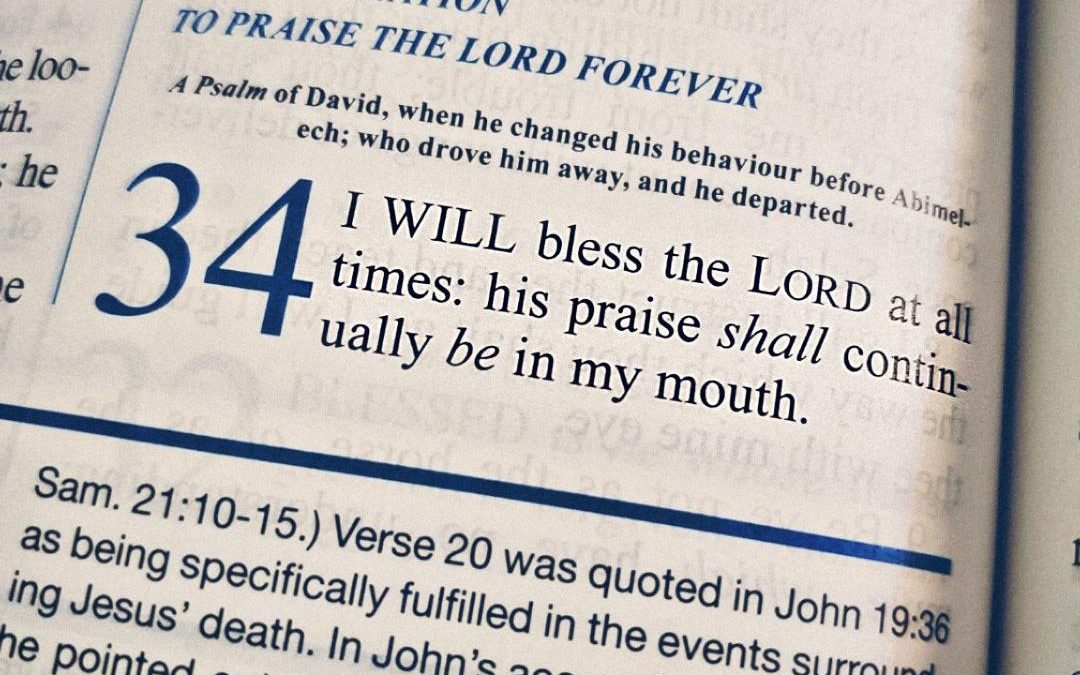
Recently, I was going through Psalms and stopped at chapter 34. I believe there are many verses in this chapter that offer a lot of comfort to those who are feeling grief, hurt, or brokenness, and so I wanted to leave you this week simply with this chapter to offer some encouragement:
I will bless the LORD at all times: his praise shall continually be in my mouth. My soul shall make her boast in the LORD: the humble thereof, and be glad. O magnify the LORD with me, and let us exalt his name together. I sought the LORD, and he heard me, and delivered me from all my fears. They looked unto him, and were lightened: and their faces were not ashamed. This poor man cried, and the LORD heard him, and saved him out of all his troubles. The angel of the LORD encampeth round about them that fear him, and delivereth them. O taste and see that the LORD is good: blessed is the man that trusteth in him. O fear the LORD, ye his saints: for there is no want to them that fear him. The young lions do lack, and suffer hunger: but they that seek the LORD shall not want any good thing….The eyes of the LORD are upon the righteous, and his ears are open unto their cry. The face of the LORD is against them that do evil, to cut off the remembrance of them from the earth. The righteous cry, and the LORD heareth, and delivereth them out of their troubles. The LORD is nigh unto them that are of a broken heart; and saveth such as be of a contrite spirit. Many are the afflictions of the righteous: but the LORD delivereth him out of them all.
Psalms 34:1-10, 15-19 (KJV)
“We are not in the land of the living going to the land of the dying. We are in the land of the dying going to the land of the living.”



 Breathe. Pray. Repeat.