3 College Tips for Finishing the Semester Strong

Missouri State University
The trees in front of Meyer Library at Missouri State University in Springfield, Missouri, with Strong Hall in the background.
Photo taken May 2020.

It’s that time again when I share tips from my years in college that helped me get through it with good grades and my sanity intact.

The last few weeks of a semester are always busy and stressful. I remember it well—prepping for finals, freaking out when you see how much material the exams cover, calculating what your overall grade might be based off the lowest score you could possibly get, skimming through piles of books and resources you’ve read throughout the semester, stressing over how many papers you have to write at once, planning classes for the next semester. Just bringing it all to memory now makes me a little anxious and weirdly energized.

Every semester, I was convinced my GPA would drop or that I would barely pass an exam or finish a paper on time, but somehow God carried me through it all. Below are three tips that helped me make it through the roughest moments during the end of a semester and prepare for the next one.

1. Don’t forsake the importance of note-taking!

Now, not every student is a note-taker. There were some classes during which I didn’t see the need or simply failed to take notes. As I advanced through college, however, I realized that note-taking was essential to my success. If a professor spent several minutes discussing an important term or event, I jotted down as many details as I could. Taking notes during classes helped me highlight important terms and information for upcoming tests and papers.

If your professor moves too quickly for you to take a lot of notes, consider recording your lectures. Toward the end of a semester, I recorded many lectures in my history and English classes to catch important details about what might be on the exam and how the exam would be structured. This method is especially helpful in preparing for finals because you can always go back to the recorded lecture and write down more in-depth notes!

2. Talk with your professors regularly.

Don’t be afraid to ask your professor every single question or bring up every single concern you have about the exam or final assignments. Really. Ask questions like, “Will such and such material be on the exam? How long of an essay response do you expect? Can we use notes on the exam?” Ask about the paper’s length, referencing style, and amount of sources. It may seem like you are bombarding your professor, but more often than not, your professor will want to help ease your concerns about the exam and give you guidance for how you should prepare for it and your papers.

It also lets your professor know how determined you are to succeed, which always factors into how they perceive you as a student and into your overall success in class. Constant communication with my professors always helped me determine how prepared I needed to be for finals and final assignments, how difficult the exam would be, and what my professors expected in the paper.

3. Prepare for the next semester.

Before registration for the next semester opened, I spent time looking up desired classes and schedules so that once registration day came, I would already know exactly what kind of schedule I wanted and register for it immediately. Classes usually fill up quickly, so don’t hesitate until the last minute or even a week or two after registration opens to plan the next semester.

Once, because I wasn’t at home when registration opened, I had my father do it for me as I coached him on the phone. Get others involved if you need help!

When you schedule classes, here are 3 things to consider: 1) the professor, 2) the time between classes, and 3) the distance between classes. You can use websites like ratemyprofessors.com to look up professors from your university and find out what to expect from each professor—how they grade, what kind of workload they give to students, and even how friendly they are. If you keep the same professors in classes of the same subjects, you’ll be able to develop a good working relationship with your professors, which will help you do better in classes in the long run!

Pay attention to what time each class you’re scheduling takes place and where they are located. During the fall semester of 2019, I had a scheduling issue after the semester began and quickly had to enroll in another class that took place only 15 minutes after my first class…at the OPPOSITE end of the campus! Needless to say, I was always rushing across campus to get to class in time, making my blood sugar drop constantly! If you schedule your classes in advance, aim for at least 30 minutes between classes that are in different buildings (15 minutes for classes that are close to each other), and try to schedule at least an hour break between a couple of classes if you are on campus all day.

Bonus tip: Do all the extra credit you can! This will help you keep your grade up in the class and keep your GPA stable should you not do as well on a final exam as you has hoped.

Siceluff Hall at Missouri State University in Springfield, Missouri. Photo taken August 2018.

Preparation and scheduling are the two most important factors to alleviate stress at the end of a semester. If you take notes, communicate with your professor, and prepare for both the finals and the next semester, you will be able to maintain good grades and be successful in college. As you look back in each semester, you may even find that preparation and a proper schedule has boosted your confidence for the next one.

And don’t forget what is perhaps the most important piece of advice regarding finishing each semester strong: when it’s all over, treat yourself to some cupcakes or cookies and take a well-earned nap to celebrate!

Just breathe, pray, and repeat.

How to Overcome Doubt with Determination

Overcoming doubt with determination by studying the Word.

Ever feel like bad things always happen to you, or like you just aren’t as lucky as those other people on social media who are living the dream and have it all together?

Ever doubt that things will work out because it seems they never do?

Sometimes, we make things harder for ourselves when all we focus on is the negative. It interferes with our ability to trust God and give Him our cares. Doubt can be crippling.

As someone who’s teetered between pessimism and optimism, I know the back-and-forth can make you emotionally and physically exhausted.

“God, I just want something good to happen in my life for once!” I’ve said before.

Our doubt blinds us from seeing how God is working, and it keeps us from moving forward with determination.

Doubt damages our determination.

After all, why bother embracing the future when you can’t see what’s ahead or when it seems bleak and uncomfortable? Why trust that things will work out when it seems nothing good ever happens?

You know, we often get stuck on patterns. If there’s a pattern of negative events in our lives, we come to expect negative things, and negativity becomes the lens through which we see life. As humans, we like patterns because they’re predictable. They give us a feeling of control. If we can predict what might happen, then we can prepare for the worst.

But God does not operate according to the predictions of man. His ways are higher.

When we learn to trust that God always has a plan for our lives, then we can turn our doubt into determination—the kind of determination that says, “I will trust in God no matter what happens.”

God's ways are higher than ours.

We say Thomas doubted that Jesus really had risen from the dead with a kind of disdain for Thomas’ attitude, but I’ve always found Thomas relatable here.

Think about it: Jesus Christ, whom the disciples had hoped would help them overthrow the government, was crucified three days prior. Their movement seemed hopeless and crushed. Bad things kept happening. And all of a sudden, a man stood in front of Thomas claiming to be the resurrected Christ. Perhaps many of us, if we had been Thomas in that moment, would feel it was too good to be true. After tragedy and disappointment, we might have responded to Jesus’ resurrection with hesitation and doubt.

Have you ever asked God for a sign if something really was Him?

God, if this is You moving, send me a sign!

Thomas declared that he would not believe until he had seen the scars in Jesus’ hands and touched His spear-pierced side. How did Jesus respond?

“Then saith he to Thomas, Reach hither thy finger, and behold my hands; and reach hither thy hand, and thrust it into my side: and be not faithless, but believing. And Thomas answered and said unto him, My Lord and my God.”

John 20:27-28 (KJV)

If we are to see Jesus, we must reach out and touch Him.

If we are to overcome our own doubt and pessimism, we must get closer to Him and believe.

Faith comes by hearing, and hearing by the Word of God!

(See Romans 10:17.)

When we study His Word, we begin to hear His voice. When we hear Him, our faith in Him grows. As our faith grows, so does our trust and our confidence in Him.

The more we seek Jesus in determination, the more our doubt will diminish.

4 Ways to Be Consistent in Prayer

How often do you attempt to organize your day perfectly, so you can spend quality time with God, and you fail?

Consistency can be difficult when we get overwhelmed with life and busy with distractions, but it is the key to having a strong prayer life.

Today’s post is taken from Bro. David Brown’s pre-sermon message on this past Friday night at Missouri District Youth Convention. Below is the transcript of an excerpt from the beginning of Bro. Brown’s Friday night message as he describes 4 ways you can be more consistent in your prayer life.

*****

1. Make it a priority.

You’ve got to make prayer first. And I know that all of you, you have things that you do right when you wake up. Hopefully, it involves something like brushing your teeth.

But I wonder if you’re struggling to make prayer a priority in your life, I wonder if you could make up your mind just between you and Jesus to say, “You know what? Before I (fill in the blank).” It could be brushing your teeth. I promise Jesus doesn’t mind your stank breath. But say, “Lord, before I brush my teeth, before I pick up my phone, before I check a text message, Lord, I’m going to spend time with You in prayer and with your Word.”

So, make it a priority.

2. Place—designate a space and time to fully be with the Lord.

I would encourage you to designate a space and a time to be fully with the Lord. Have a place, whether that’s in your bedroom or a specific place in your bedroom. Maybe it’s even in your closet. But have a place where you can eliminate distractions, and you can set aside time just to be with Jesus.

3. A.C.T.S.—have a plan.

I don’t know about you, but at some point, I got tired of going into that time of prayer, and I say, “Hallelujah, thank you, Jesus,” about 1,000 times, and I say that’s prayer. So, I just have a very simple plan. I can’t even remember the first time where I saw it, but my plan is very simple: it’s A.C.T.S.

I start my time with the Lord by adoring Him, by worshiping Him, by just talking about how awesome God is. Then, I go into confession, and I confess the things I’ve done that I shouldn’t have done and the things I should’ve done that I didn’t do, for to him that knows to do good and doesn’t do it, to him it is sin. And I also confess each day that I could not live this day without Him.

And from confession then I move into thanksgiving, and I begin to thank the Lord for the incarnation, that the Word was made flesh and dwelt among us. I thank God for the life of Jesus Christ that though He was tempted in every way as I’m tempted, He was without sin so that He might present Himself a sinless sacrifice. I thank God for every spiritual blessing, every good gift, every perfect gift. I thank God for every spiritual blessing, material blessing, physical blessing.

And after I thank God, then I begin to seek Him. I begin to seek the Lord, and I usually begin by putting on the armor of God, putting off the works of the flesh, and putting on the Lord Jesus Christ. And then I allow the spirit of God to lead me where to pray and what to pray. So, a plan.

4. Playlist—Helps Clock Disappear

And last but not least…this is totally odd-school, but it’s helped me, and perhaps it will help you.

Have a playlist, a set of songs that you pray to, that you don’t necessarily sing to, but they just serve as a means of getting rid of the clock. You forget about the time because you build a playlist—you know exactly how long it is, and so if you’ve got to be somewhere in 30 minutes, have a 30-minute playlist. If you’ve got to be somewhere in 45 minutes or 60 minutes, have a playlist that serves that time.

And typically, I build my playlist to follow my plan. The first song is all about worship, and the second song about confession, and the third song about thanksgiving and seeking the Lord. Before you know it, if I’m praying a playlist, and I’m praying confession or adoration during a song, six minutes and seven minutes and five minutes passes, and before you know it, I’ve spent 30, 45 minutes with the Lord.

*****

The above tips from Bro. Brown are excellent helps for taking a practical approach to be more consistent in your daily prayer life.

If we want to get to the altar and allow God to change us, we must first be consistent in prayer. We must 1) make it a priority, 2) have a place and time designated to be with God, 3) make a prayer plan, and 4) build a playlist to pray along with.

Bro. Brown also mentioned that subscribing to Spotify or Apple Music might be worth the investment if you want to build a prayer playlist so that advertisements do not pull you out of the presence of God:

“There’s nothing like being there with the Lord, and all of a sudden an advertisement for Home Depot comes on. You’ll get out of the altar real quick!”

Bro. David Brown

If we build consistent prayer lives, we’ll be able to develop a closer walk with Jesus, allowing Him to mold and lead us according to His Will.

“Praying always with all prayer and supplication in the Spirit, and watching thereunto with all perseverance and supplication for all saints;”

Ephesians 6:18 (KJV)

“Pray without ceasing.”

1 Thessalonians 5:17 (KJV)

2 Lessons from the Lame Man and the Blind Man: Learning to Recognize Jesus in Your Life

Holding the Bible up to the sky.

What will it take for you to see God in your life?

In the book of John, we see two examples of Jesus healing two separate men—a lame man and a blind man—who both had opportunities to recognize Jesus as their God who had personally touched their lives. Only the blind man recognized God. As for the lame man, there is no record of his salvation, but there is record of his disobedience and lack of gratefulness. When we look at both accounts together, we can see from their differences how important it is to not only glorify and recognize God in our lives but to do whatever it takes so that we can see Him. There are at least two ways the lame man and the blind man differed.

1. They differed in their responses to their peers.

A man looks over the mountains, and a caption reads, "One thing I know: I was blind, now I see."

Both the lame man and the blind man were honest when answering the Jews’ questions about their healings, but the lame man cared more about the interests of his peers while the blind man was able to see through the Jews’ questioning and recognize their antagonistic motives.

“The Jews therefore said unto him that was cured, It is the sabbath day: it is not lawful for thee to carry thy bed. He answered them, He that made me whole, the same said unto me, Take up thy bed, and walk. Then asked they him, What man is that which said unto thee, Take up thy bed, and walk? And he that was healed wist not who it was: for Jesus had conveyed himself away, a multitude being in that place. Afterward Jesus findeth him in the temple, and said unto him, Behold, thou art made whole: sin no more, lest a worse thing come unto thee. The man departed, and told the Jews that is was Jesus, which had made him whole.”

John 5:10-15 (KJV)

“Therefore said they unto him, How were thine eyes opened? He answered and said, A man that is called Jesus made clay, and anointed mine eyes, and said unto me, Go to the pool of Siloam, and wash: and I went and washed, and I received sight. Then said they unto him, Where is he? He said, I know not….They say unto the blind man again, What sayest thou of him, that he hath opened thine eyes? He said, He is a prophet.”

John 9:10-12, 17 (KJV)

The now-healed lame man was at first unable to identify Jesus by name after he deferred blame to Him, but once he learned who it was who had healed him, he went back to the Jews to inform them that it was Jesus “which had made him whole.” The blind man appeared to care more about pleasing the Jews who were after Jesus than obeying Him. The healed blind man, however, knew Jesus by name and (inadequately) described Him as a prophet.

As they questioned him further, he discerned the Jews’ motives to catch Jesus and remained true to his testimony, refusing to be swayed by his interrogators. Pay attention to his response below:

“He answered, and said, Whether he be a sinner or no, I know not: one thing I know, that, whereas I was blind, now I see….Then they reviled him, and said, Thou art his disciple; but we are Moses’ disciples. We know that God spake unto Moses: as for this fellow, we know not from whence he is. The man answered and said unto them, Why herein is a marvellous thing, that ye know not from whence he is, and yet he hath opened mine eyes….Since the world began was it not heard that any man opened the eyes of one that was born blind. If this man were not of God, he could do nothing.”

John 9:25, 28-30, 32-33 (KJV)

The formerly blind man was now defending Jesus against the Pharisees’ accusation that Jesus was a sinner, discerning their attempts to disprove his story and smear Jesus. He pulled from his theological knowledge to expose the flaws in the Pharisees’ argument, confirming to them that if Jesus had been a sinner, He would not have been able to heal the blind man, proving that He was “of God.” The healed man’s bold and clever responses to the Pharisees resulted in them casting him out of the synagogue (ex: “They answered and said unto him, Thou wast altogether born in sins, and dost thou teach us? And they cast him out” [John 9:34, KJV]). Even though the healed man knew what might happen to him, he stood his ground against the Pharisees.

2. They differed in their responses to Jesus.

Jesus bends down and draws in the sand.

While both men initially obeyed Jesus’ instructions to be healed, the formerly lame man disobeyed Jesus later and failed to recognize who He is, whereas the formerly blind man responded to Jesus with both recognition and praise. Notice the blind man’s response to Jesus below:

“Jesus heard that they had cast him out; and when he had found him, he said unto him, Dost thou believe on the Son of God? He answered and said, Who is he, Lord, that I might believe on him? And Jesus said unto him, Thou hast both seen him, and it is he that talketh with thee. And he said, Lord, I believe. And he worshipped him.”

John 9:35-38 (KJV)

The now-healed man recognized Jesus as Lord and worshipped Him, eager to believe. When Jesus told the formerly lame man not to sin anymore, the man turned right back around and tattle-taled on Jesus to the Jews.

One man recognized Jesus as Lord, and the other man failed to see who Jesus is, and his information to the Jews resulted in the Jews’ plan to persecute and kill Jesus.

From both of these accounts, we can glean at least two lessons:

1.) We must value God and the things he wants from us above all things, even if it costs us.

2.) We must not forget to give Him the glory for all He’s done for us.

The formerly blind man recognized and praised Jesus even after the Pharisees had excommunicated him from the synagogue for his defense of Jesus, but the formerly lame man did not recognize or believe on Him. He placed more value in pleasing the Pharisees. In fact, he showed no interest in obeying or praising Jesus whatsoever, perhaps proving he was the true blind man as were the Pharisees for lacking spiritual vision (see John 9:39-41).

A boy looks up at the sunset over the trees. A caption reads, "What will it take for you to see Jesus?"

What will it take for you to see God in your life and give Him the glory?

We may find ourselves going through the motions and doing what we’re told (as both men initially did when Jesus gave them instructions to be healed), but as we learn from the account of the lame man, we can still fall short of recognizing God at work in our lives.

Each day, we must look inside ourselves to ensure we are placing Jesus above all things in our lives. Getting closer to Jesus requires an attitude of willingness, devotion, dedication, and sacrifice. The kind of attitude that says, “No matter what it may cost me, I will stand by Jesus and testify of this truth.” The kind of attitude that makes us willing to remove anything that might keep us from recognizing Jesus. The kind of attitude that says, “I will do whatever it takes to follow and obey Him no matter what.”

If we want to see Jesus, we must devote ourselves to Him, give Him the glory, worship Him alone, and tell the world of His greatness.

2 Reminders For When You’re Dealing with Stress or Imposter Syndrome

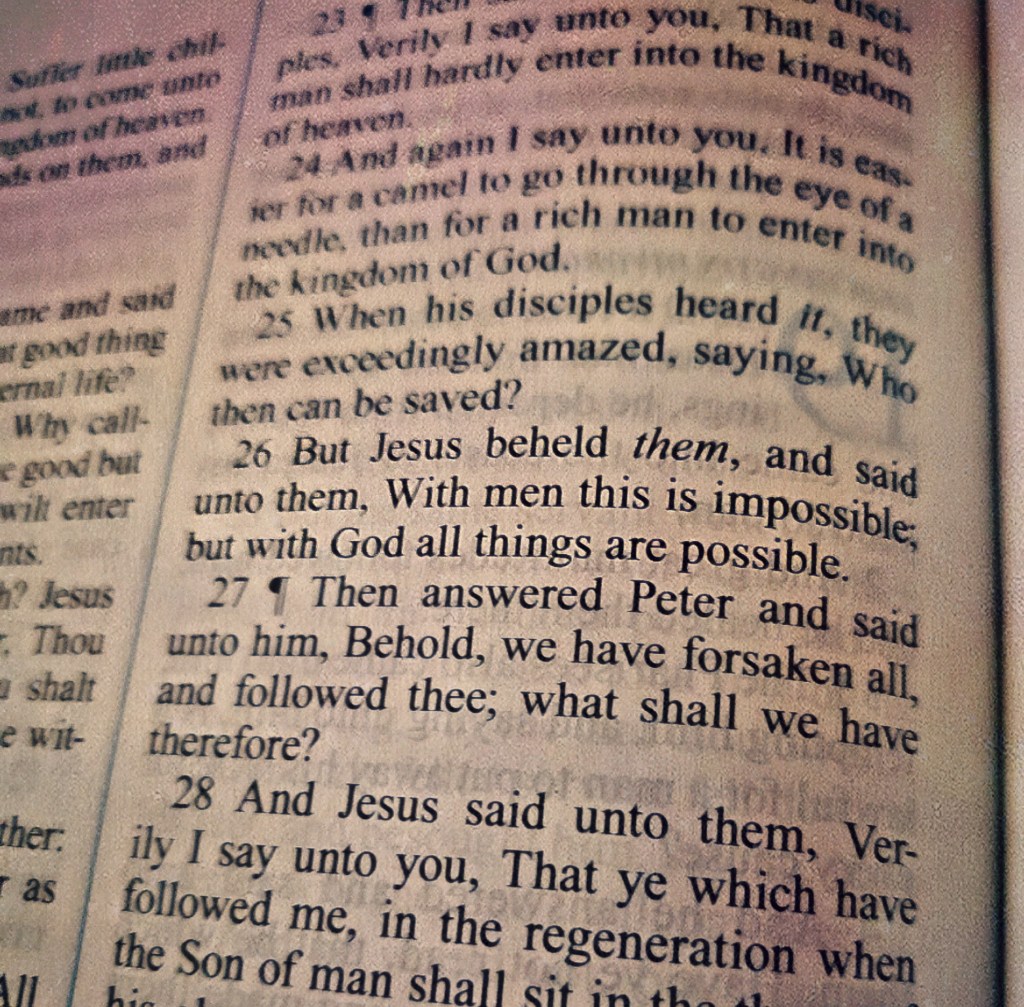
Matthew 19:26 in the King James Bible.
Matthew 19:26 reminds us that all things are possible with God!

Do you ever feel as though you’re the camel carrying the basket of straw about to burst and that the straw that will break your back is only moments away?

I am not enough.

You might say this silently to yourself or to God in prayer as you wearily reflect on all the things you have to do and your limited abilities.

I can’t do this.

It’s true.

You are not enough…on your own. You can’t do this alone.

When I’m struggling with imposter syndrome, worrying people may realize how inadequate I am, or when the stress of life weighs me down, here are 2 reminders that give me strength to carry on:

1. Everything I do I must do for Jesus to the best of my ability.

“And whatsoever ye do, do it heartily, as to the Lord, and not unto men;

Knowing that of the Lord ye shall receive the reward of the inheritance: for ye serve the Lord Christ.”

Colossians 3:23-24 (KJV)

Imposter syndrome causes a person to feel like a fraud, doubting his or her own abilities or accomplishments. I’ve struggled with this often, but each time I do, God reminds me that it doesn’t matter what others may think of what I can or can’t do or of what I have or have not accomplished. What matters is that no matter what I do, I must do it wholeheartedly for His glory.

Whether it’s your work or ministry, as long as you keep your focus on God and direct your efforts and attention toward Him, then you will be able to overcome feelings of doubt and inadequacy.

2. All things are possible with God.

“I can do all things through Christ which strengtheneth me.”

Philippians 4:13 (KJV)

When you have a heavier load than usual, it can seem impossible to get everything done. On our own, we cannot fulfill each of our duties and maintain peace of mind, but with God, we can do all things because He is our strength.

Sometimes, life presents us with seemingly impossible tasks. But God has equipped us with all we need to do all He’s called us to do.

God has given us everything we need to live in this world according to His Word—Himself.

When we become worried about failure or inadequacies, we must put our focus on Him.

Redirecting our focus to Jesus reminds us what this is all for and why we’re here. It’s for Him. We work, go to school, and survive in this world to support the Kingdom and become stronger members of the Kingdom. He gave each of us unique abilities and placed us in specific locations to serve Him and His Kingdom.

We are enough to our God!

When we serve God and give ourselves and abilities to Him, He makes up the difference in our lives. We may have the weight of the world on our shoulders, but He’s got the whole wide world in His hands.

How to Live for Jesus in a Sin-Sick World

Walking with Jesus.

How can you be in the world and not of the world?

How do you live in the world and not love the world?

As I’ve gotten older, I’ve noticed more and more young people I’ve seen grow up in the church or come into church as teenagers proceed to turn away from church once they reach the young adult years. As Christ’s return quickly approaches, it is disheartening to see these young people leave their love for the Lord and righteousness and give into worldly lusts. Yes, the world has many temptations, and it can be hard to resist the things our friends or society tell us are popular or fun. But if one loves God and attends church, how it is possible that he or she might end up choosing the world instead? How does one manage to live right in a sin-sick world and not fall into darkness?

After all, there are temptations and spirits of darkness everywhere, trying to pull us away from the Lord.

Well, it all boils down to one thing: your personal commitment to and relationship with Jesus Christ.

In order to stand firm in your beliefs and live for Jesus rather than the world, you must develop within yourself a love of righteousness, holiness, and the Lord and His Word.

Here are 3 ways you can resist the world and live for Jesus:

1. Don’t let yourself develop an appetite for worldly things.

The things we consume will influence our appetite and priorities.

Is that show or movie you’re watching coming between you and your relationship with God? Is the music you’re listening to causing you to speak or think more about worldly appetites than wholesome thoughts? Are you more enthusiastic about a tv show than talking with your friends about Jesus? Are you more exuberant in your praise at a football stadium than at the altar in a worship service? If you don’t let yourself love the things of the world more than the things of God, you’ll be able to be in the world and still stand for righteousness and holiness. Understand where those worldly things & behaviors lead you.

2. Develop an appetite for the things of God.

In order to do this, you can begin by replacing unhealthy habits with righteous ones. For example, instead of listening to worldly music on the way to church, listen to music that brings you closer to God. Instead of looking at Bible studying as a chore, find ways to make it more enjoyable by using study guides, Bible journals, and other interactive Bible study tools. As you read the Word more and apply it to your life, you’ll begin to see how His Word & Spirit will change you, and you’ll find yourself no longer wanting the things of the world but the things of God.

3. Surround yourself with God-first people.

My church school gang at a reunion.

One of my lifelong spiritual leaders has always said this phrase:

“If you can’t change your friends, change your friends.”

This doesn’t mean we can’t associate with and witness to people of the world. Of course, we absolutely should! But if those people with whom we’re spending most of our time are beginning to have a negative influence on us and are taking us further from the Lord, then it’s time to step away from those relationships. This doesn’t mean that we’re shutting them out and turning up our nose at them in a self-righteous attitude. It does mean recognizing that for our own salvation, we may need to distance ourselves from negative influences while still praying for those friends and their salvation.

You will become like the people with whom you surround yourself.

If you surround yourself with people who mock righteousness and holiness and resist the things of God, then you’ll drift further away from Him. If you surround yourself with Godly, God-first, and God-only people, then you’ll be able to grow in your relationship with God, loving and longing only for the things that please Him.

The world is intoxicated and diseased with sin. It’s dying, and it’s pulling so many lost souls into eternal suffering.

But when we live for Jesus and resist the world, we tell people that there is so much more to life than worldly pleasures and living for ourselves.

Temporal pleasures are, of course, fleeting. They don’t last. But the love of Jesus within us gives us lasting joy, contagious joy that spreads and overcomes the allure of this world.

When we live boldly for Jesus in this world and love Him more than the things of the world, we’re sending His message of hope to the lost that sin and death no longer have power over us when we surrender to Jesus Christ.

3 Ways to Maintain Our Spiritual Health

Chainmail, Soldier, Spiritual Battle, Protection

No one likes their flaws exposed. We wrap ourselves in armor to protect our egos, but are we wrapping ourselves in the armor of God to protect our souls?

“You don’t want people seeing the chinks in your armor,” I wrote in a creative nonfiction class last year. “Chinks. What does that mean? A weak point, a place of vulnerability, an opening for an attack from the enemy. A minor flaw, so says the online dictionary, or weakness in a plate of armor. A detrimental flaw. A special flaw. There’s an interesting phrase. A special flaw. It’s a special point of weakness that directs the enemy where to attack an otherwise invulnerable person. Are you invulnerable?”

Vulnerability is something of which many of us afraid. After all, who welcomes an attack from the enemy with open arms? We don’t want to be vulnerable, but sometimes, we allow ourselves to become vulnerable when we do not take care of our spiritual well-being. One missing or weak link can be deadly.

In a history class on the Spanish Conquest in 2019, I held a coat of chainmail as my professor lectured on the weapons of the Conquest. It was a small section of a coat of chainmail—about a 12-inch square. Remembering my professor’s lecture, I later described in my essay for a creative nonfiction class how the Europeans manufactured the chainmail while they rested between battles: “A blacksmith would take thousands of tiny metal or steel rings and carefully interlink them by hand. A single coat of chainmail could take months to finish if a skilled blacksmith worked 10-hour days.” If the blacksmith didn’t do his job correctly, it could spell death for the unlucky soldier wearing the flawed coat of chainmail. I became so fascinated with the concept of the process of creating a coat of chainmail that I reflected on its significance—and spiritual parallels—even more in my own writing.

“You imagine the misery of knitting steel for a living in 90-degree weather with 60-percent humidity in the Yucatan Peninsula,” I wrote, “trying to get a piece of chainmail done for a hotshot conquistador so he’s a little more likely to survive the arrows or stabbing spears of the Mayans than the footman who came over for gold and glory with only a helmet and a crossbow….You imagine the fever of smallpox getting to you while linking those steel rings and skipping a section right where the coat will slip over the conquistador’s left shoulder. If the Maya or Aztec crossbowmen spot the opening, the glory-seeking conquistador won’t last long. One small missing chink in his armor, and the obsidian arrow blade will tear through the chainmail as though it were linen instead of steel. A special weakness.”

At this point, you may be wondering why I’m going on about the history of developing chainmail in the Spanish Conquest and including excerpts from my own writing. As a deeply private person, vulnerability has always been a relevant topic to me. Those of us who like to keep things close to the chest tend to guard ourselves with more caution. But there are times when we may all be guilty of caring more about preserving our pride than protecting ourselves from spiritual attacks.

When we’re not prepared and protected, we give the enemy an opportunity to attack. There are at least 3 things we can do to ensure our chainmail is not missing any links:

1.) Stay prayed up.
2.) Stay well-read.
3.) Stay clothed in the armor of God.

(11) “Put on the whole armour of God, that ye may be able to stand against the wiles of the devil.
(12) For we wrestle not against flesh and blood, but against principalities, against powers, against the rulers of the darkness of this world, against spiritual wickedness in high places.
(13) Wherefore take unto you the whole armour of God, that ye may be able to withstand in the evil day, and having done all, to stand.”
~Ephesians 6:11-13 (KJV)

Do we have on the helmet of salvation? Are we carrying the sword of the Spirit? How’s our daily Bible reading? Are we keeping up a daily prayer life?

The armor of God is necessary for our spiritual protection. We are warriors in the Lord’s army, and our battles are spiritual. Just as soldiers must keep their armor in its best condition to protect themselves from harm, so must we keep our armor in its best condition through daily prayer & Bible reading. This also requires frequent checkups of our armor to ensure we’re not missing a crucial piece.

If we aren’t maintaining our spiritual armor, then we are allowing ourselves to be vulnerable to the enemy’s attacks due to our own laziness or carelessness. Without a helmet on, we expose our minds to sinful thoughts. If our shield of faith is missing, then we expose ourselves to the enemy’s arrows.

Proper preparation and protection will help us repel the enemy’s attacks.

Though God is always with us to win the victory, we cannot use His protection as an excuse to be careless with the upkeep of our spiritual well-being.

We may labor under harsh conditions as the blacksmith labored in the Spanish Conquest to develop a flawless coat of chainmail, but our labor is not in vain when we approach our work with purpose and dedication.

We labor in the Kingdom, we pray, and we study the Word so that we can withstand the attack of the enemy, so that there are no chinks in our spiritual armor, so that there are no missing links in our coat of chainmail.

One missing link can be deadly.

So, examine yourself each day and ask this question:

Are you vulnerable?

3 College Tips for Newbies & Pantsers: Midterm Edition

Strong Hall
Missouri State University
College
Strong Hall on a rainy day at Missouri State University in Springfield, Missouri.
Picture taken May 2020.

If you’re newer to this blog, you might not be aware that at certain points during the semester, I post some tips for those who are new to college or who tend to fly by the seat of their pants and put things off until the last minute. I believe it is essential that we try our best in every aspect of our work to reflect a godly character and strive toward excellency in all we do. Many of these tips are also applicable to those in high school, and we can even apply the lessons these tips explore to our lives beyond college.

*****

Midterms are almost here, and so are many big exams and paper due dates. Here are 3 tips I found helpful in preparing for exams and papers throughout my 5-year college experience:

1) Highlight key points & terms in textbooks or sources where you can.

For example, one history professor I had always provided us with a master list of terms we would need to know before each exam to properly define and describe them in paragraph form. Of course, we had no way of knowing which terms she would choose, and the list included some 60 terms out of which she would choose only a handful. Now, I felt she was pulling a Satan move on us, but after freaking out, I was determined to do well on the exam.

I searched through every document and page of every source we’d read thus far, highlighted each term, and wrote everything down about each term that I could find. The areas I focused on were the following: who, what, where, why, when, and how. Then, I wrote down the significance of each term. Doing so helped me prepare and pass my professor’s rigorous exams.

As you read your sources, any term or definition you come across is always worth highlighting and remembering just in case it comes up again later.

2) Plan your essays.

Do it. Even if you tend to be a pantser. A brief outline that simply states your essay’s topic and supporting points will go a long way in helping you create an organized paper that may earn you a good grade.

Brainstorm your ideas. Do some freewriting. Write down ideas for your essay’s intro paragraph and support for your main points. Write down the sources you’ll use to support each main point. Write down ideas for the significance of your essay’s topic that you will reflect on in the conclusion.

If you plan your research and an outline at least seven days before your paper’s due date, then you’ll have at least five to six days to write a page or two each day and finish just in time.

Pro tip: if you prepare two weeks in advance, you’ll have time to send your draft to your professor to get his or her tips on what you should change before the due date.

3) Take time every day to relax.

My ethics professor once explained how he never allowed himself to study so much in college that he couldn’t make time for his social life or to relax throughout the week. This was one of the best pieces of advice any professor had ever given me. I found that through applying his advice, I managed to enjoy my life even when I was juggling several papers and exams due at the same time.

College is stressful. You should be responsible and do your work on time. However, you should also take the time to be around your family and friends and (most importantly) spend time with God. If you study well and prepare for your papers, you’ll find you have more time during the week to relax for an hour or two each evening.

Read a book. Chat with your family. Spend more time in prayer. Take a nap.

Just breathe, pray, repeat, and relax, and you will get through it.

*****

The above are tips that apply to far more than just college experiences. Preparing for important projects in the workforce and adult world is essential for success. Taking the time out to enjoy your life with family and friends is essential for your mental and emotional health. Prioritizing your time with God is essential for your spiritual health.

We must never let ourselves become too lazy or too stressed or too busy that we don’t approach our work and relationships wisely and seriously.

If you know someone in college or even high school who’s struggling, share these tips with them as an encouragement. College is not forever, but the lessons one learns in college will help them get through the rest of life.

3 Scriptures to Speak Over Anxiety

Anxiety

What will the future hold?

That’s a question we often ask ourselves when life seems more uncertain than usual.

Bills pile up. We’re saving for trips, home maintenance, or a new home or car. We’ve got work and school responsibilities, or we’re in need of a job or financial blessing. It seems we often waste our days away in nervous expectancy for what won’t or could happen. But that’s not what God wants for us.

Anxiety can absolutely consume our thoughts and affect our physical health. I sometimes get more stressed just thinking about stress, and then I try to put away all those things causing me anxiety, which causes me more stress because I know they’re still out there.

For those who struggle with anxiety, overcoming our worries often involves a process of reminding ourselves throughout each day that God knows what we’re going through and has a plan for us. He is our Provider and Comfort.

If you’re battling anxiety, here are 3 passages of scripture to study and speak over your fears so that the Lord can calm the troubled thoughts within your busy mind and speak peace over the storm in your life:

(8) I will instruct thee and teach thee in the way which thou shalt go: I will guide thee with mine eye.
(9) Be ye not as the horse, or as the mule, which have no understanding: whose mouth must be held in with bit and bridle, lest they come near unto thee.
(10) Many sorrows shall be to the wicked: but he that trusteth in the LORD, mercy shall compass him about.
~Psalms 32:8-10 (KJV)

(3) Thou wilt keep him in perfect peace, whose mind is stayed on thee: because he trusteth in thee.
(4) Trust ye in the LORD for ever: for in the LORD JEHOVAH is everlasting strength:
~Isaiah 26:3-4 (KJV)

(6) Be careful for nothing; but in every thing by prayer and supplication with thanksgiving let your requests be made known unto God.
(7) And the peace of God, which passeth all understanding, shall keep your hearts and minds through Christ Jesus.
~Philippians 4:6-7 (KJV)

Our God has a plan for each of us. He is faithful, and He never fails.

No matter what you’re facing, rest assured that He is right there with you.

He will guide you.

He will keep you.

He will give you peace.

3 Steps to Mastering Consistency in Your Life

Prayer, coffee, and the Word.

When we’re stuck in a spiritual rut, life always seems to get out of focus. Our days are rushed, our mind is busy, and no matter how hard we try, moving forward is practically an impossibility. How do we juggle our hectic lives, overcome our flesh, and maintain a healthy relationship with our Creator? The answer is both simple and complex—consistency.

We have to learn to be consistent in our lives in order to live a life dedicated to serving the Lord and His Kingdom while fulfilling earthly duties, such as work and school. Consistency is the key to unlocking our potential as children of God and living a purposeful life. But there are three components, three steps we must take in order to master consistency in our daily lives.

Step 1: Consistency in Thought

We must make up our mind every day that we will serve the Lord.

“Casting down imaginations, and every high thing that exalteth itself against the knowledge of God, and bringing into captivity every thought to the obedience of Christ;” ~2 Corinthians 10:5 (KJV)

When we keep our mind stayed on Christ and our thoughts in obedience to Him, then our lifestyle, our actions, and our words will follow suit. We must choose every morning to serve the Lord, and throughout each day, we must continue in righteous thoughts, remembering our resolve to serve Him and only Him. Consistency must begin in the mind.

Step 2: Consistency in Word

Consistency must also continue into our speech. If we only act the part at church but speak unwisely outside of church, then our words betray us and reveal our heart.

(34) “O generation of vipers, how can ye, being evil, speak good things? for out of the abundance of the heart the mouth speaketh.

(35) A good man out of the good treasure of the heart bringeth forth good things: and an evil man out of the evil treasure bringeth forth evil things.

(36) But I say unto you, That every idle word that men shall speak, they shall give account thereof in the day of judgment.

(37) For by thy words thou shalt be justified, and by thy words thou shalt be condemned.”

~Matthew 12:34-37 (KJV)

Our speech must exalt the King and reflect His Spirit within us. This is why it is essential that we maintain righteousness in thought. If we first determine in our minds to follow and serve the Lord, then we begin to allow His Spirit to dictate our words to others. His Spirit within us helps us guard our tongue and keep our speech in check. Consistency in word will lead to a more righteous life.

Step 3: Consistency in Deed

Of course, it is not enough to mentally choose each day to serve God or to pay only lip service to serving Him, but our actions must follow suit as well, and we must become consistent in our deeds.

(23) “And whatsoever ye do, do it heartily, as to the Lord, and not unto men;

(24) Knowing that of the Lord ye shall receive the reward of the inheritance: for ye serve the Lord Christ.”

~Colossians 3:23-24 (KJV)

Consistency in our actions requires not only a conscious, daily decision to serve the Lord, but it also requires making smarter choices. We can replace unhealthy or unhelpful habits with spiritual ones. For example, instead of starting the day on our phone for half-an-hour, we can begin our day by reading the Word. Consistency in deed requires making decisions to put God first, such as building consistent prayer lives and daily Bible study sessions. Consistency in these areas should then carry over into our actions around others, showing the world His character in us through our righteous actions.

Once we have learned how to become consistent in each of these three areas, then we will truly be able to show the world the transforming power of our God. When we become consistent in living for Him, others will notice, giving us the opportunity to become active soulwinners and grow the body of Christ. Becoming consistent is not easy, and there will be days in which we will fail. And that’s okay. But we must then become consistent in our determination to get back up each time we fall and strive harder to serve Him more.

Consistency brings results.

It brings us closer to God, and as we become consistent in our daily walk with Him, we learn to love Him and His Word more. We learn to replace old habits with spiritual ones. And we learn the value in making up our mind each day to live for God in righteousness, in checking and guarding our speech (and our thoughts!), and in choosing each day to become more like Jesus and to become the people He has called us to be.