BPR Post Schedule Update

Happy Friday, BPR readers! Today I just have a brief announcement about the post schedule for you all. I am moving the post schedule back by a week because the next few blog posts will fall during weeks that I will be involved in church events. So, the next post will be next Friday the 20th, and posts will be every other Friday after that as usual.

I hope you all have a lovely day, and I can’t wait for you to read the next blog post. Stay tuned!

~Caitlin

Praise ye the LORD. Blessed is the man that feareth the LORD, that delighteth greatly in his commandments.

Psalm 112:1 (KJV), Verse of the Day

2 Principles of Spiritual Growth

Where do we grow from here?

This was the title of Rev. Victor Jackson’s Friday night message at Missouri Youth Convention a couple of weeks ago. At every youth convention, congress, or camp, there are always powerful messages from anointed preachers. Through each message, God ministers, and He moves. But there is always at least one message in particular that stands out. Everyone has their own “favorite” message that spoke to them in particular. Well, ever since the Friday night service of Missouri Youth Convention, I’ve been thinking about Bro. Jackson’s message on growth.

Growth has been a topic I’ve thought about often over the years as God has helped me navigate various life struggles and situations. So, for today’s post (which I know was supposed to go live yesterday—my apologies for the delay!), I wanted to share with you an extension of some of my notes from the message “Where Do We Grow From Here,” highlighting two principles of spiritual growth. Also, I do share post updates and topic ideas on my Instagram, so please be sure to go ahead and follow me there if you aren’t already so that you can find out when posts may be delayed or about upcoming topics. (You can find my Instagram account by clicking here.)

Without further delay, here are two principles of spiritual growth.

1. Don’t make a small start your identity.

Everybody’s gotta start somewhere, right? Whether it’s in your ministry or personal relationship with God, you must begin small. In order to grow your prayer life, for example, you may begin by praying 15 minutes a day consistently and extending that over time. As Victor Jackson said, however, “It is a blessing to begin small. It is a curse to end small.”

We should all start out at small beginnings, but that isn’t where we should end up.

“If you’re not growing, you’re living outside of God’s purpose for your life.”

Victor Jackson

We are meant to be producing spiritual fruit. An apple tree will not produce apples if it stays in the state of a small seed or the size of a twig. When we grow, we become stronger and produce spiritual fruit. The righteous man experiences spiritual growth like what the beginning of Psalms describes when comparing the godly versus the ungodly:

And he shall be like a tree planted by the rivers of water, that bringeth forth his fruit in his season; his leaf also shall not wither; and whatsoever he doeth shall prosper.

Psalms 1:3 (KJV)

2. Don’t put limits on your elevation.

People often limit how you can grow. As soon as God starts using you more and growing your ministry, there are people who judge you. They place limits on how much a person can grow in his or her walk with God. We may even fall privy to the idea that we should only grow to a certain extent and no further so as to prevent others from believing we’re trying to make everything about ourselves or to try to prevent ourselves from becoming prideful. So, we stay small and claim it’s out of humility.

Humility is an essential attribute of a true Christian character, but Bro. Jackson pointed out that we are not meant to use our humility as an excuse to remain small and refuse to grow into what God wants us to be.

“Humility is not a destination; it is an attitude,” he explained. “If you don’t want to grow, your humility in remaining small just became disobedience. Obedience is a pathway. You’re supposed to be going and growing. Get to growing and knowing this is what the kingdom is.”

Indeed, spiritual growth is about letting God use you more in the ways that He wants to so that His Kingdom can grow through each of our efforts. That’s why we should teach more Bible studies, pray more, fast more, become more involved in ministry, and do all that He asks us to do. As we mature in Christ and grow, we become more well-rounded Christians and more effective in ministry and in the Kingdom.

And beside this, giving all diligence, add to your faith virtue; and to virtue knowledge; and to knowledge temperance; and to temperance patience; and to patience godliness; and to godliness brotherly kindness; and to brotherly kindness charity. For if these things be in you, and abound, they make you that ye shall neither be barren nor unfruitful in the knowledge of our Lord Jesus Christ.

2 Peter 1:5-8 (KJV)

Follow after God’s direction in your life, and you will grow. Spiritual growth is stunted when you stop putting effort into your ministry and walk with God. A lack of effort leads to a lack of growth, and a lack of growth leads to spiritual death.

“You were destined to grow. You were destined to go beyond.”

Victor Jackson

We must always be striving to do more for the Kingdom, more for God, more for others, more in our ministry, and more than we’ve done yesterday and ever before in order to reach this lost world and get closer to Jesus. We cannot forsake the importance of growing in every aspect of our lives.

We were destined to grow.

How to Study the Word More Thoroughly: The Re-Reading Method

Hey, BPR readers! As you’re reading this (that is, if you’re reading this on Friday, April 15, 2022), I am at Missouri Youth Convention with our church youth group where young people across the state of Missouri are worshipping God together, receiving the Holy Ghost, and hearing anointed messages from the Lord for their lives.  As such, today’s post is a bit simpler, but I hope you find it helpful!

Today, we’ll be diving into one Bible study method I’ve been using that’s helped me study the Word more thoroughly. One of our associate pastors at my church once mentioned the phrase “digging for diamonds” when mentioning Bible studying and how we ought to dig deep and truly search the Scriptures for understanding if we’re going to know the Word and draw closer to God.

I dubbed this Bible study method the “re-reading method.”

Read, then re-read, then re-read, and then re-read again.

That’s right. It seems like a pretty basic Bible study method. Just read the Word, right? Well, there’s a lot more to it than that. Last year, I read the Bible through, but I’ve always found it difficult to truly study the Word when I’m just trying to get through a certain number of chapters in a day so I can meet my goal.

So, this year, I’ve been reading through Romans, and I’m on my 3rd go-round now. The re-reading method involves at least 5 steps, but you can alter this to suit your style.

1) Read the book you’re focusing on straight through.

Yes, the first step is really that simple. Set a daily reading goal and read the book through within a week or a month.

2) Start from the beginning again, taking brief notes along the way this time.

The notes can be as simple as rephrasing a key verse in your own words that you want to highlight, jotting down a recurring theme or purpose, or noting how you can apply a verse to your life.

For example, when I went through Romans chapter 6 for the second time, I took these quick notes as I read verses 15-23: “Grace compels us to righteousness. The more God gives us grace and mercy, the more we want to live righteously for Him. As we grow in righteousness, it leads us to a greater desire to reflect His glory and Christ-like character.”

3) On the third read-through, take more time with each section of every chapter.

Write more thorough notes about what is going on in the chapter and how it relates to other verses, chapters, and concepts. I recommend using a concordance or the Apostolic Study Bible for this step as the footnotes and cross-references are great resources to study the Word more thoroughly.

When I read Romans chapter 6 for the third time, I took more detailed notes, referring to the footnotes in my study Bible for more information on the concepts of being dead to sin and living righteously.

4) On this read-through, study a collection of verses a day, whether it’s 4-8, and break down each verse.

I like to call this the word study. It’s a study of certain words that might stick out to you, for which you’ll need a Strong’s concordance or Bible dictionary to get to the root meaning of each word. On this step, you might write down how the original text’s definitions enrich and deepen our understanding of Scripture. By now, your notes will begin to build off each other from the previous read-throughs, resulting in a more layered Bible study approach.

5) Read through the book again using a related daily devotional or study book.

The final step in the re-reading method is optional, but it involves re-reading the book again but with a corresponding devotional or study book on the specific book you’re reading.

For example, I have a devotional from The Daily Grace Co on the book of Colossians that I’ve used to answer prompts about the verses as I read through the chapters. Reading someone else’s study of a particular book or passage in the Bible and using the prompts they give you can help you think more critically as you ponder how to respond to a prompt about applying a verse or concept to your daily life.

By the time you’ve finished with this method of Bible studying, you’ll have re-read the same book several times in a row, digging deeper into the Word each time and hopefully gaining a greater understanding of what God is telling us through His Word. If we are going to draw nearer to God and become who He wants us to be, we must study the Word – not merely read it each day to check off a box on a to-do list but really, truly, earnestly study the Word and search the Scriptures.

After all, Jesus is calling us to a deeper relationship with Him.

“Thy word have I hid in mine heart, that I might not sin against thee.”

Psalm 119:11 (KJV)

“Study to shew thyself approved unto God, a workman that needeth not to be ashamed, rightly dividing the word of truth.”

2 Timothy 2:15 (KJV)

3 Responses to 1 Question: What Shall I Do With Jesus?

“What shall I do then with Jesus?”

Pontius Pilate asked this question in Matthew 27:22 when the Jews took Jesus to Pilate before they crucified Him. This past Sunday morning, my pastor – Pastor Tony Wyatt of Apostolic New Testament Church in Mount Vernon, Missouri – taught a Bible study about this crucial question. It forces us to make a decision we all must face: how to respond to the reality of Jesus and salvation in His Name.

What will you do with Jesus?

For today’s post, let’s go over three responses to this question from Pastor Wyatt’s fantastic lesson, which you can watch in its entirety by clicking here.

1. Avoid Him

There are people who choose to avoid thinking about Jesus in their lives. These may be people who call themselves agnostic, believing that God may exist, but they choose not to live for Him anyway. And there are people who avoid thinking about Jesus by claiming He doesn’t exist.

Pastor Wyatt described three kinds of people who will not be in Hell: atheists, unbelievers, and make believers. An atheist in Hell is no longer an atheist. Those who did not believe Jesus is God will no longer be an unbeliever. Those who only pretended on earth will no longer be able to pretend in Hell. Once they arrive in Hell, it will be too late to accept that Jesus is real, that He is God, and that they should give their lives to Him.

Those who avoid Jesus may do so because of past hurt or because they don’t want to believe that people will be ultimately judged for their sins, but avoiding the truth does not make it go away or protect you from the consequences of ignoring the truth.

2. Evade Responsibility

Pilate had the responsibility upon him to decide what to do with Jesus, but he wanted to pass it on to someone else. So, Pilate sent Jesus to Herod to let him take care of the situation.

When Pilate heard of Galilee, he asked whether the man were a Galilean. And as soon as he knew that he belonged unto Herod’s jurisdiction, he sent him to Herod, who himself also was at Jerusalem at that time.

Luke 23:6-7 (KJV)

Pilate tried to evade the responsibility he had by trying to find an easy way out. He had Jesus scourged to try to appease the crowd, and he tried to see if the crowd would let Jesus be released instead of the murderer Barabbas, but on both counts, Pilate’s judgment was wrong (see Matthew 27 and Luke 23). The crowd did not want Jesus to be merely punished. They were seeking to kill Jesus and nothing less.

Just as Pilate tried to shirk his responsibility, we cannot do the same when it comes to our salvation. We cannot rely on someone else’s relationship with God to save us. We are all responsible for our own salvation and our own relationship with Jesus.

“Those who go into eternity without God will have no one to blame but themselves.”

Pastor Tony Wyatt

3. Accept Him

Finally, there are those who accept who Jesus is and answer the call to live for Him. He is our Savior, our Healer, our Restorer, Redeemer – He is our everything!

“If you believe something, you’ll do something about it.”

Pastor Tony Wyatt

The most important question you can ask yourself is “what am I going to do with Jesus?”

Ignore Him? Mock Him? Not believe in Him?

If you believe in Jesus, you’ll choose to serve Him. Those who believe they will spend eternity in either Heaven or Hell will do something about it! And those who choose Jesus have rewards on earth. We are delivered from sin, we become joint heirs with Christ, and we have the promise of eternal life (see Romans 8). We need to fall upon His grace and mercy while we have the opportunity to repent, be baptized in Jesus’ Name, receive the Holy Ghost, and live for Him!

No matter what you may go through, only Jesus can take care of each situation in your life. No matter what you’re facing, Jesus is the answer!

I encourage everyone to listen to the full Bible study (which starts at the 13:00 minute mark) as Pastor Wyatt goes over the history behind Jesus’ arrest and trial and those involved as well as what Jesus endured and why He came. It’s important for us to study and know what Jesus went through for us, how He came and died and rose again so that we could live forever with Him.

Oh, how He loves us!

The Burning Bush Experience and Four Points of Reflections on Exodus 3:1-4: A Guest Post by Dr. Rafael Machuca

Now Moses kept the flock of Jethro his father in law, the priest of Midian: and he led the flock to the backside of the desert, and came to the mountain of God, even to Horeb. And the angel of the Lord appeared unto him in a flame of fire out of the midst of a bush: and he looked, and, behold, the bush burned with fire, and the bush was not consumed. And Moses said, I will now turn aside, and see this great sight, why the bush is not burnt. And when the Lord saw that he turned aside to see, God called unto him out of the midst of the bush, and said, Moses, Moses. And he said, Here am I.

Exodus 3:1-4 (KJV)

1. Stay faithful in the things of God.

As the above passage of scripture opens, we find Moses traveling to the backside of the desert. He was traversing a hot, barren place alone, leaving behind him the comforts of home, companionship, and support. Regardless of his circumstances, Moses continued to faithfully take care of the flock that had been entrusted to him by his father-in-law. He was a support for his family even though it put him in a difficult situation. As he put the care of the flock before his own comfort, he was completely unaware that he would soon be called to lead God’s flock, the children of Israel.

Any time we do work for the church or support the leaders over us, it is important to remember to do it all unto God. It is not unusual to experience situations that make you feel like you are working alone in the desert. Maybe you are the only one showing up for prayer, willing to teach a Bible study, or participating in evangelism. It can be easy to wonder where everyone else is. If your eyes are not on the Lord, the work can become very wearisome in your own eyes. However, when you do it unto God, you can take comfort in knowing that God notices your hard work and determination. He knows exactly where you are and the work you are doing to further His kingdom.

2. God will utilize all parts of your life for His Glory.

The mountain Moses came to was called Horeb, also known as Mount Sinai. Even though Moses had been raised by Egyptians and then spent decades as a fugitive in the desert, God knew that every experience he had and every land he learned to traverse would be beneficial to help lead the children of Israel out of captivity. When God uses us, He does so knowing every past experience will become a skillset to be used in the future.

Do not let yourself believe you have no skills or talents to offer.

God can use your Bible quizzing experience, years of living faithfully, your secular work experience, and even the knowledge born out of learning from mistakes. The key is to give ourselves totally to God so He can use us for His purpose and His glory.

3. God uses your surroundings to get your attention.

A bush burning in the desert would not have been an unusual sight. It would have been easy for Moses to see the fire but shift his focus back on moving the flock away and continuing with his daily tasks.  However, he gave this situation enough attention to realize something was different, and doing so, he witnessed a “great sight.”

God used a seemingly normal occurrence to get Moses’ attention as he was going about his day. What in our surroundings is God trying to use to get our attention? It may be a situation at work or with family or friends. At first sight, everything may appear insignificant and normal. But further inspection may reveal the Lord at work getting our attention for a greater purpose.

4. When God calls, answer.

As Moses turned aside to witness the bush burning yet not being consumed, God had succeeded in getting his attention. However, the Lord’s intentions went far beyond that. God does not just want to get our attention. All who are willing to stop and turn toward God can have the opportunity to hear Him calling. It is a call filled with love and a purpose, and all who hear will get to choose if they are willing to answer that higher calling.

This passage in Exodus 3 paints a beautiful picture of how God will set things in motion to get your attention. From the burning bush to the call, don’t be too busy living life that you miss what God really has for you. He is just waiting for you to look toward His direction to call you into a deeper walk and a deeper life with Him.

*****

Dr. Rafael Machuca is a VA Hospital Chaplain at the John J. Pershing VA Medical Center in Poplar Bluff, Missouri. He studied and received his Doctor of Ministry degree at the Assemblies of God Theological Seminary in 2020. Dr. Machuca served his country in the United States Marine Corps from 1993 – 1997 and has been honoring and paying tribute to U.S. veterans ever since.

Understanding Weakness: On Mistakes, Perfection, and Forgiveness

You’re going to make mistakes. God doesn’t hate you for that.

This is what I should have told myself years ago when I was starting out in college.

It was the spring semester of 2016, and I was taking a mix of online and seated classes at a community college while working part-time as a tutor at the writing center. One of my online classes was a world history course with my history professor from the previous semester—Mr. Z we called him. He was the fun, quirky professor always eager to chat with his students. I met with him multiple times to discuss my papers and upcoming exams, and during one particular meeting, we discussed a paper I was writing for another history class that he was helping me perfect.

As I settled into my seat across from him, I gazed in horror at his marked-up version of my draft on his desk. How could I—I have made that many errors?! Mr. Z sensed my panic and quickly explained.

“Relax, it’s not terrible,” he said with a chuckle. “I’m pushing you harder because I know you’re at the level where you can handle it.”

It wasn’t much of a comfort. I wanted my work to be near-flawless, and he knew that. I always wanted to know all the answers, and if I didn’t, I didn’t want anyone else to know it. When I explained my (admittedly) flawed mindset, Mr. Z said something to me that I’ve never forgotten.

He said, “You don’t want people seeing the chinks in your armor.”

“No, I don’t!” I said (a bit surprised that he hit the nail dead center). You see, I believed that if people saw the chinks in my armor, it meant they would see me as weak, vulnerable, incapable—human.

Sometimes, you just don’t want to be that real with people. You’d rather just go through life with no one knowing anything about what you’re going through or how you feel deep down. That way, when you mess up, there’ll be no one to judge you and no one to know that you don’t always make the right choices.

Making mistakes is for weak people, I told myself, and weakness is wrong.

Yes, weak people make mistakes, but as humans, we are all weak by nature, having an imperfect and sinful nature by default. Weakness isn’t necessarily wrong. It’s just natural. That’s why we need God. Through Him, we receive strength to overcome our flaws. What I failed to understand then was that it is OKAY to admit that you’ve made a mistake. You are only human, and God doesn’t punish you for that.

Our sinful nature and inclination to make mistakes doesn’t give us license to make whatever mistakes we want just because, but it does mean that our mistakes should come as no surprise to ourselves. God isn’t surprised that we fall and fail and make bad choices, and He doesn’t expect us to be perfect. There is none perfect but Him. He doesn’t beat us up when we make a bad choice, and neither should we condemn ourselves.

No matter how many times we mess up, if we truly repent and seek forgiveness, then God is faithful to forgive us of our sins (see 1 John 1:9).

When you realize that God’s grace extends to you no matter how many mistakes you make, then you’ll be able to extend that same grace to others.

It was when I learned how to release the self-condemnation that I felt for the mistakes I’d made that it was easier to forgive others for the things they’d done wrong. They were only human like me, after all. I could see my own flaws, my own imperfection in others and knew that if God didn’t hold my mistakes against me, then I shouldn’t hold others’ mistakes against them.

If you don’t forgive yourself, how can you truly forgive others?

You are not perfect. You will continue to make mistakes. But guess what?

It’s not the end of the world if you do. God’s grace is sufficient to cover your sins (see 2 Corinthians 12:9), and His strength is more than enough to help you overcome your weaknesses.

There hath no temptation taken you but such as is common to man: but God is faithful, who will not suffer you to be tempted above that ye are able; but will with the tempation also make a way to escape, that ye may be able to bear it.

1 Corinthians 10:13 (KJV)

There is a way to escape the consequences of our weak nature—salvation in the name of Jesus and doing our absolute best to live as He has instructed us to live. God created us to be imperfect beings in need of our perfect Creator.

Lean into that.

Give your flaws, mistakes, and all your baggage up to Him.

It’s okay if you fail. Just remember that God never fails.

It’s okay that you’re not perfect and what you do isn’t perfect. Just remember that His love is perfect.

If you fully surrender to God and trust Him with all you have and all you’ve done, He will take care of you, and you’ll be closer to Him than you were before.

5 of My Favorite Things

Head on over to my Instagram (@caitlinhale_bpr) for more Christian lifestyle and modest fashion content!

It’s Friday, it’s almost spring, and in southwest Missouri, we’re having the last night of our annual camp meeting services tonight, so today’s post is going to be a fun one! 

If you all like this post, I may be posting a few more fun ones throughout the year. Don’t forget to stay tuned for the next BPR post on March 4th where we’ll be talking about perfectionism, mistakes, and the background of my creative post from last time!

People often ask each other questions from what I like to call “The Favorites Game.” What’s your favorite song? What’s your favorite color? What’s your favorite ice cream flavor? It can get monotonous at times — especially when you’re an introvert and you have to try to think of your answers quickly in order not to look like an idiot in front of your history class on the first day. Case in point:

Mrs. Teacher clasps her hands together and asks, “So, Caitlin, what’s your favorite color?”

“Uh…” I say, scratching my head. 

“Yes?”

“Cheese.”

“Cheese?” Mrs. Teacher takes her glasses off. 

“Yeah.”

“You mean yellow?”

“Yellow?” Now, I’m confused. “That’s not a pizza topping. Yellow what?” Bell peppers maybe?

“Pizza topping? We’re on colors now.” 

“I thought we were on pizza toppings.”

“But that’s not even on our questions list.” She flips through the pages on her clipboard. “Where did you—?”

“Chocolate.”

“Chocolate isn’t a color! Well, it could be…” She pushes her glasses back up the bridge of her nose, glancing over her notes.

“Oh, are we not on ice cream flavors now?”

“No, no,” she says, rubbing her forehead with two fingers, still clutching her pen in hand, “we’re still on colors.”

“Oh.”

“Now, Caitlin. I’ll ask you again. What is your favorite color?”

“Uh….” Beads of sweat begin to trickle down my hairline. 

“Yes?”

“Hmmm.” Could she be staring at me any harder? 

“Go on,” she says, leaning over her desk, with a bit of a break in her voice that suggests she’s either about to cry or lunge over her desk and strangle me. 

“I…don’t think I have one.”

Mrs. Teacher throws up her clipboard, ripping her glasses off again. 

The above example may be fictional, but suffice it to say, The Favorites Game was a nerve-wracking game to play in person when I was in school, and I much prefer it in an online forum! Below are five of my favorite Christian-related things. Read through the list and think about what your answers would be!

1. Who is your favorite person in the Bible (other than Jesus)?

I know. This is a hard first question. 

There are so many great people written about in the Bible that’s it’s hard to choose just one, but I’m going to go with Esther.

She risked her life for her people, and her story is an example of a true, godly woman. What’s the thing the young kids say these days? “Go, Queen?” Well, it so applies to Queen Esther!

2. What is your favorite Christian music genre?

Worship. 

Yes, that sounds vague. But I’m not talking about contemporary, radio music, Christian rock or rap, or sleepy, lullaby songs.

I’m talking old-fashioned, hair-pin flying, shoe-kicking, tie-swinging WORSHIP songs where all you want to do is throw up your hands and surrender everything to God. The kind of music that makes you want to jump or shout, dance or cry, and just give God the glory. The kind of songs that you don’t care who’s watching you when you sing along and worship our King!

Songs like “I Give You Glory,” “Jesus Said It,” “He Made the Difference,” “Shake The Foundation,” “But God,” and a medley of “I’ve Got It,” “Bless That Wonderful Name,” “He Brought Me Out of the Miry Clay,” and “Joy Unspeakable.” 

(For the record, though, I do love a ton of other Christian songs and genres!)

David danced and worshipped unashamedly before the Lord, and we ought to, too!

3. What is your favorite book or Scripture in the Bible?

This is a two-for-one question. One question, one possible answer to either of the two parts of this question. 

My answer is Psalms and Ecclesiastes 3:1-8 (which you can read a post about here). 

4. What is your favorite Christian song?

This one is a bit of an extension of question 2, and it’s also a hard question for me to answer. So, I’m going to go with one of my classic favorites: Eddie James’ “Breakthrough.” 

With scriptural lyrics like “You are the undefeated one/My light and my salvation/When the wicked, my enemies and my foes/Came upon me to eat up my flesh/They stumbled and fell!” and powerful lyrics like “Breakthrough in my weakness/Breakthrough in my struggle/You are the God/You are the God of the/Breakthrough!” this is a classic praise and worship song! Plus, it brings back memories of being out-of-breath on the praise team as we would take off our shoes and jump and shout in worship while singing this song!

He is the God of the breakthrough!

5. What is your favorite Christian-based film?

Amazing Grace is hands down the best Christian-based film ever. You’ve got a historical drama with enough humor, romance, action, legal drama, and history to satisfy, well, anyone! It’s such a stirring, moving film about the true story of William Wilberforce’s part in the movement to end the slave trade in England. Plus, it also features the true story behind the classic hymn “Amazing Grace!”

It’s truly a top-notch film that you can and should watch with your family again and again. Aaand now I may have to go rewatch it soon!

Honorable mention: The Prince of Egypt. Another stirring and beautiful film based on the biblical account of Moses! Love this one, too!

All right, I’ll stop babbling now (insert goofy face emoji here).

If you have any favorites in these categories, let me know what your answers are in the comments!

“Are You Invulnerable?”: A Brief Essay on Flaws and Expectations

Last month, I asked through a poll on my Instagram stories who might like to read more of my own creative work and hear more about their background and topics related to the content within my past writings. The response was a unanimous “yes,” and so for today’s post, I’m sharing with you all one of the short essays I wrote for a nonfiction writing class in 2020. I’ll be sharing a bit more in the near future about the story behind this particular short essay and delving into the topics of perfection, expectations, and imposter syndrome. Let me know in the comments or on Instagram what you think of this essay and what you think it means!

********

You don’t want people seeing the chinks in your armor.

Chinks. What does that mean? A weak point, a place of vulnerability, an opening for an attack from the enemy. A minor flaw, so says the online dictionary, or weakness in a plate of armor. A detrimental flaw. A special flaw. There’s an interesting phrase. A special flaw. It’s a special point of weakness that directs the enemy where to attack an otherwise invulnerable person. Are you invulnerable?

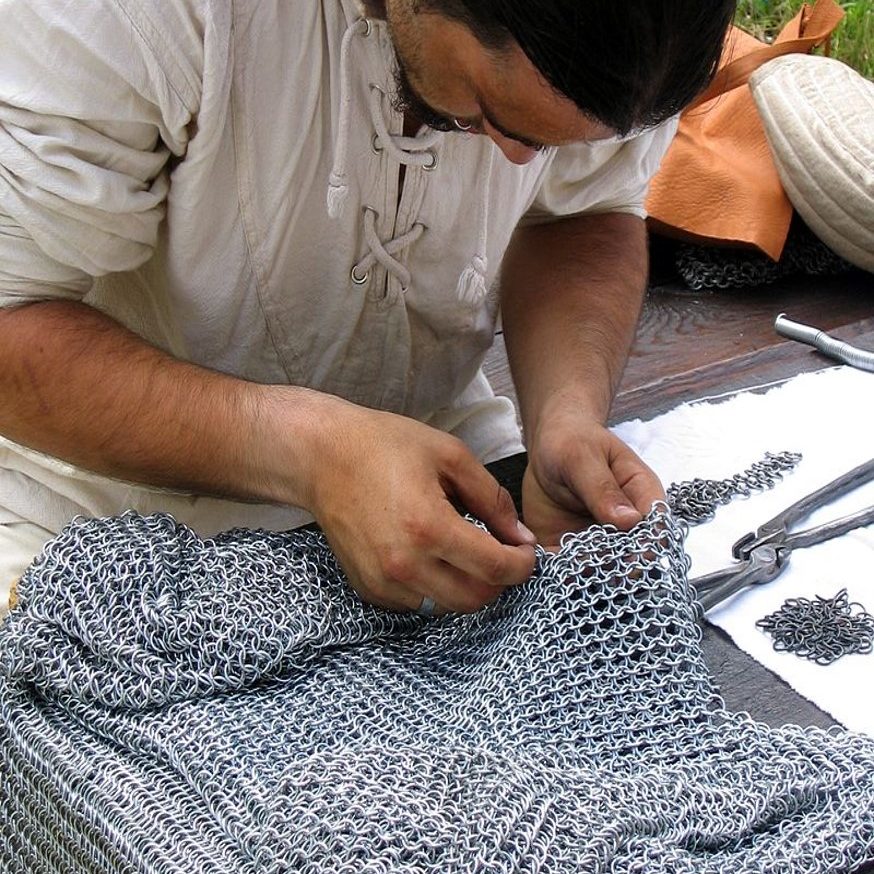
You’ve held a coat of chainmail—last fall in your history class on the Spanish Conquest. The professor brought in a bit of chainmail for everyone to handle so you all could know how hard the stuff must have been for Europeans to fight in and wear in the heat of Mexico over their wool clothes while holding heavy swords and lances, that is if they could get their hands on one. You put the chainmail on your arm and held it there for a minute. It was a bit like when you stuck your finger in the bowl of cold ice water that the Titanic Museum in Branson, Missouri had cooled to 28 degrees Fahrenheit—the temperature of the water the night the doomed ship sank. You held it there when you were about 14 to see how long you could last.

About 30 seconds.

You lasted with the chainmail on your arm about that long, too, because it started to get heavy, and your wrist started to twitch, and the classmate behind you wanted a chance to hold it, so you passed it on.

(Picture courtesy of Dr. John Chuchiak.)

It was a small section of a coat of chainmail—perhaps about 12 inches wide and long. Dr. Chuchiak lectured on how the Europeans manufactured it while they rested between battles. A blacksmith would take thousands of tiny metal or steel rings and carefully interlink them by hand. A single coat of chainmail could take months to finish if a skilled blacksmith worked 10-hour days.

You imagine the misery of knitting steel for a living in 90-degree weather with 60 percent humidity in the Yucatan Peninsula, trying to get a piece of chainmail done for a hotshot conquistador so he’s a little more likely to survive the arrows or stabbing spears of the Mayans than the footman who came over for gold and glory with only a helmet and a crossbow because that’s all he could afford and figured the gold he’d take from the natives would make him rich enough for 20 crossbows, 50 horses, and a land grant. You imagine the fever of smallpox getting to you while linking those steel rings and skipping a section right where the coat will slip over the conquistador’s left shoulder. If the Maya or Aztec crossbowmen spot the opening, the glory-seeking conquistador won’t last long. One small missing chink in his armor, and the obsidian arrow blade will tear through the chainmail as though it were linen instead of steel. A special weakness in an otherwise invulnerable person.

No.

You don’t want people seeing the chinks in your armor, but it’s not because you’re afraid they’ll attack you. You don’t want to let them down or let them see you’re just as human and weak as they are. You’d rather not cry under pressure or in front of others. You say you’re like a machine, doing what you’re supposed to.

But machines break down, and sooner or later, you’ll crack, too.

********

Stay tuned for more posts like this and a special study on depression and mental health coming in the near future. Be sure to follow along with the counterpart to this blog on my Instagram for more Apostolic lifestyle content!

Don’t forget to share your thoughts with me on this post in the comments! I’d love to hear from you!

How to Overcome a Victim Mentality: A Guest Post by Kayla Carmichael

(Photo courtesy of Kayla Carmichael.)

The sad part is this: not everyone actually wants to be healed.

Some are okay remaining exactly who they are and the way that they are. A victim mentality has stolen more lives than I believe we would like to admit. It takes work to heal, it takes work to work through our own dysfunction, it takes work. Thankfully, we are not alone on our journey, but we do play a part in it.

There was a time in my life not too long ago that I was a victim to my own story, to what happened to me, to the pain that people had caused me. It is so easy to become a victim, and when we have been hurt, we often can have a longing to feel justified for being a victim. I mean, we are hurting, after all.

Does anyone see me? Does anyone care about me? Does anyone know that they are the reason why I am the way that I am?

I learned one morning as I began to speak to God about some things that had happened to me. I was just so sad. I simply did not understand why this happened to me. I then remember feeling this thought of, “Kayla, do you realize that you do not have to feel this way? You do not have to remain in this mindset. Do you realize this? It is time to close the doors to your past.”

Now, this does not mean that we are not to deal with what has happened to us accordingly. We do not dismiss our pain, but we release it to the Lord, and we become vulnerable in His presence. We decide that we are no longer going to be a victim of what has happened to us. Of what someone has done.

Victory is a choice.

Where the Spirit of the Lord is there is freedom. If I am not walking in victory, it is because I have decided not to walk in victory. However, walking in victory does not mean I am now “no longer hurting.” It simply means I am going to pick my head up and yield completely to the Lord as He heals me and as He restores me.

So, what will I decide? Will I decide to continue to worship my pain, or will I decide to worship my God? The God I choose to worship is the God who will determine my outcome.

Every. Single. Time.

You are a victor, not a victim.

********

Kayla Carmichael is an Apostolic writer and a great example to younger generations of what it means to love and live for God no matter what. Moving from Ohio, she came to Urshan College in Florrisant, Missouri and is now in her senior year, majoring in Christian ministry. Her goal is to pursue a master’s in counseling. Between devoting her time to school and church, Kayla is also writing her first book. Be sure to follow along with her insightful posts on Facebook and Instagram (@k.carm12)!

Welcome to 2022: A Bit About The New Year, Jonah, and Forgiveness

Happy New Year 2022 from yours truly!

Welcome to 2022!

This first post of 2022 is going to be pretty simple and casual because, to be honest, things are already starting to get crazy busy, and my mind can’t focus long enough this week to spend 3+ hours writing anything!

First order of business, I just want to say thank you to everyone who is reading this and beginning the new year by keeping up with Breathe Pray Repeat. It means SO much to me! Second order of business, I wanted to share a thought with you today on something that’s been on my mind for a while now, and it involves perception, forgiveness, human nature, and the account of Jonah.

From all the things I’ve heard said about Jonah throughout my life, I’d say the dude gets a pretty bad rap. Of course, he did literally try to run away from God’s commandment and was angry when God wanted to show others mercy, only being truly distressed when his plant died. But if I’m going to be completely honest with you, I have to say that I find Jonah incredibly relatable. You see, it’s easy when we read the Word to separate ourselves from the people we’re reading about as though we would never act or think like they did when they made mistakes. Sometimes, it’s easy to think of them as mere 2-D historical figures playing out a role in our heads rather than real, regular people. When we do that, we forget our own human nature.

Jonah did NOT like the people of Nineveh to say the least, and as I read a little about Nineveh, I began to understand why Jonah felt as he did. Nahum called it “the bloody city,” and witchcraft, murder, fornication, and other evils were abundant in Nineveh’s society (see Nahum 3). Suffice it to say, they were a truly wicked people committing unspeakable horrors and egregious evils. It’s completely understandable why Jonah, who knew full well what kind of people the Ninevites were, would not want God to pardon them (however wrong he was in his response).

Put yourself for a moment in Jonah’s sandals. You’ve seen and heard what the Ninevites do, and then all of a sudden, God tells you to go preach to them, and knowing God, you KNOW He will show them mercy. And (because you know how much evil they’ve done), you don’t want them to be given mercy. No. You want them to be punished. After all, how could they do all that evil and then get a free pass?

Ay, but there’s the rub. Therein lies the flaw in your thinking. And therein lies the point of the book of Jonah.

It isn’t about all the bad things the people of Nineveh did. They truly repented, and God always honors true repentance, and He offers forgiveness and mercy even though we don’t deserve it.

What shall we say then? Is there unrighteousness with God? God forbid. For he saith to Moses, I will have mercy on whom I will have mercy, and I will have compassion on whom I will have compassion.

Romans 9:14-15 (KJV)

Our human nature doesn’t want to look past people’s mistakes. That’s why we often want to hold grudges against others for hurting us. That may even be why we may want to judge Jonah for the mistakes he made. Our expectations of others can make us forget our own human nature and flaws.

God extended grace and mercy to the people of Nineveh as He does to you and me. He is faithful and just to forgive us of our sins if we turn from our wicked ways and seek after Him. Jonah shows us an interesting study of human nature, but it also shows us that God wants us to be forgiving towards others as well.

No matter what so-and-so did or said to hurt you or others, forgive them. No, they don’t deserve mercy, but neither do you. God GIVES us grace. We don’t earn or deserve it. Our flesh causes us to judge others and hold grudges, but it’s the Spirit of God within us that helps us show mercy and love.

So, that’s it for today! It’s true that even after what we know about Jonah, I still relate to the dude for how real and imperfect he is. There is an account out there that states he came to his senses after the end of the recorded book of Jonah and praised God, so there IS hope even for us stubborn people!

Thanks for reading the first BPR post of 2022! There should be a guest post on here in the next couple of weeks, so stay tuned for that as well.

God Bless,

Caitlin